نمط العوالم والانتقالPattern of Worlds and Transition
من الكوارك إلى المادة: رحلة التشكّل
أخذتُ ورقة بيضاء وقلماً، وجلستُ أرسم.
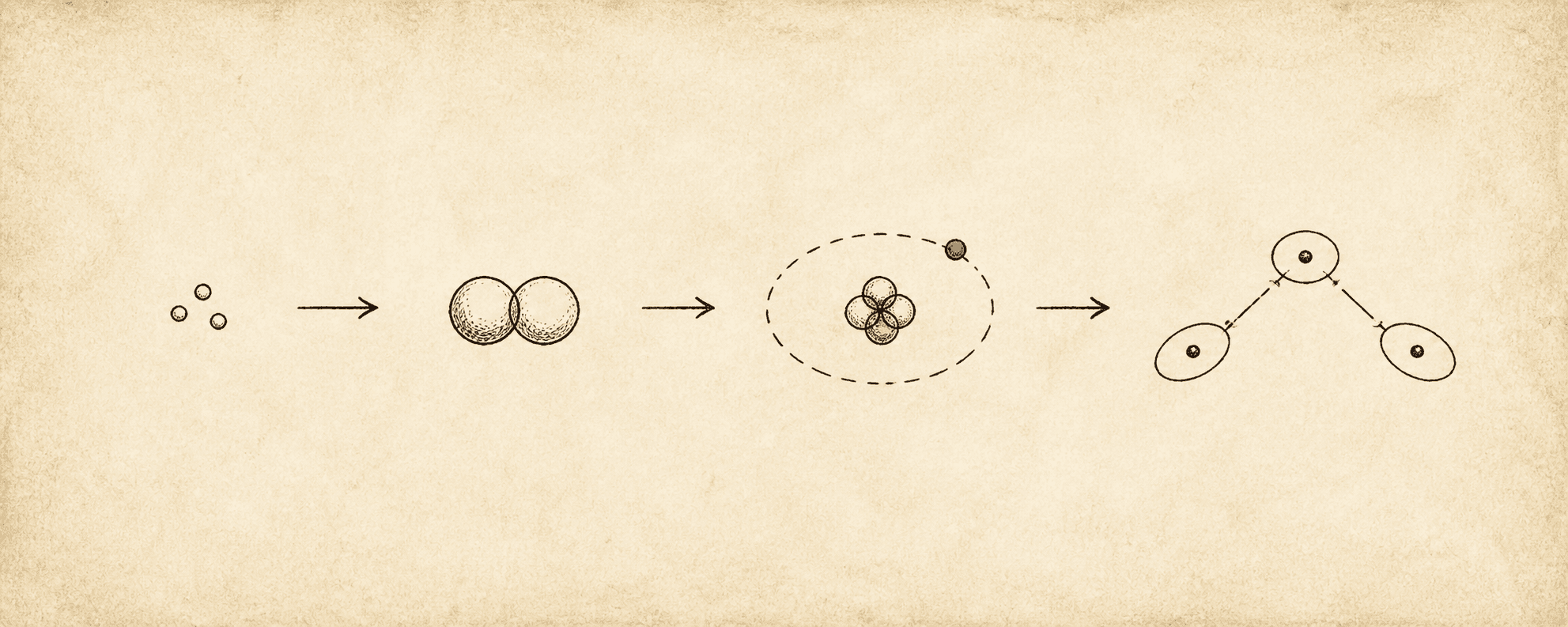
لم أكن أرسم صورة بالمعنى الفني، بل كنتُ أحاول أن أرى الفكرة أمامي. رسمتُ دوائر صغيرة تمثل الكواركات، ثم أسهماً تربطها ببعض، ثم دوائر أكبر تمثل ما ينتج عنها. كنتُ أحاول أن أفهم الرحلة: كيف يتحول شيء صغير لا يُرى إلى هذا العالم الذي أراه حولي؟
على الورقة أمامي، بدأت الصورة تتضح.
الكواركات هي البداية، فيما يعرفه العلم حتى الآن.
جسيمات متناهية الصغر، أصغر بكثير مما يمكن للعين أن ترى حتى بأقوى المجاهر. توجد منها أنواع مختلفة، لكل نوع خصائصه. وحين تتحد أنواع معينة منها مع بعضها، ينتج شيء جديد.
بعض التوليفات تنتج ما يسمى بالنيوترون. وبعضها الآخر ينتج البروتون. هذان هما اللبنتان الأساسيتان اللتان ستُبنى منهما الذرة.
رسمتُ ذلك على الورقة: كواركات تتجمع، فتظهر نيوترونات وبروتونات.
لكن الذرة لا تتشكل بعد.
النيوترونات والبروتونات تتجمع معاً في المركز، في ما يسمى بالنواة. عددها هو الذي يحدد نوع العنصر. ذرة فيها بروتون واحد هي ذرة هيدروجين. ذرة فيها بروتونان هي هيليوم. وهكذا تتنوع العناصر بتنوع عدد البروتونات في نواتها.
لكن النواة وحدها لا تكفي. الذرة لا تكتمل ولا تستطيع أن تتفاعل مع العالم إلا حين يأتي الإلكترون.
الإلكترون جسيم صغير يحمل شحنة مختلفة عن شحنة البروتون. يدور حول النواة، يحيط بها، يفعّلها. حين يأخذ الإلكترون مكانه، تصبح الذرة كاملة، جاهزة للتفاعل، قادرة على أن تبدأ مهمتها في بناء العالم التالي.
أضفتُ ذلك إلى رسمتي: النواة في المركز، والإلكترون يدور حولها.
الآن تبدأ المرحلة التالية.
الذرات المكتملة تتفاعل مع بعضها. تتحد وتنفصل وتتحد من جديد، وفق قوانين تحكمها. من هذا التفاعل تنشأ المادة التي نعرفها: الماء حين يتحد الهيدروجين مع الأكسجين، الحديد حين تتجمع ذراته بطريقة معينة، الهواء والتراب والصخر وكل ما نراه ونلمسه.
رسمتُ المرحلة الأخيرة: ذرات تتفاعل، ومادة تظهر.
نظرتُ إلى الورقة أمامي.
كواركات تتجمع فتنتج نيوترونات وبروتونات. هذه تتجمع فتنتج نواة. الإلكترون يأتي فتكتمل الذرة. الذرات تتفاعل فتنتج المادة.
سلسلة واضحة. كل مرحلة تبني التي تليها. كل عالم ينتج العالم التالي.
لكن السؤال الذي بدأ يلحّ عليّ: كيف يعرف كل مستوى ما يجب أن يفعله؟ الكواركات حين تتجمع، كيف "تعرف" أن تنتج نيوترونات وبروتونات؟ والذرات حين تتفاعل، كيف "تعرف" أن تنتج هذه المادة بالذات؟
هل هناك شيء ينتقل بين هذه المستويات، شيء أكثر من مجرد المادة والطاقة؟
طويتُ الورقة ووضعتُها جانباً. الرحلة من الكوارك إلى المادة أصبحت واضحة أمامي. لكن السؤال عن كيفية انتقال المعرفة بين هذه العوالم... هذا ما أحتاج أن أفهمه الآن.
النمط الكوني: الإنتاج وانتقال المعلومات
قانون الإنتاج: كل عالم ينتج عالماً أعقد
في ليلة هادئة، جلستُ أمام نافذتي الصغيرة في تلك الغرفة المستأجرة.
كان الشارع في الأسفل شبه خالٍ، وأضواء المدينة البعيدة تومض في الأفق. أخذتُ ورقة كبيرة وبدأتُ أرسم ما فهمتُه حتى الآن. ليس رسماً علمياً دقيقاً، بل خريطة للعوالم كما تشكّلت في ذهني.
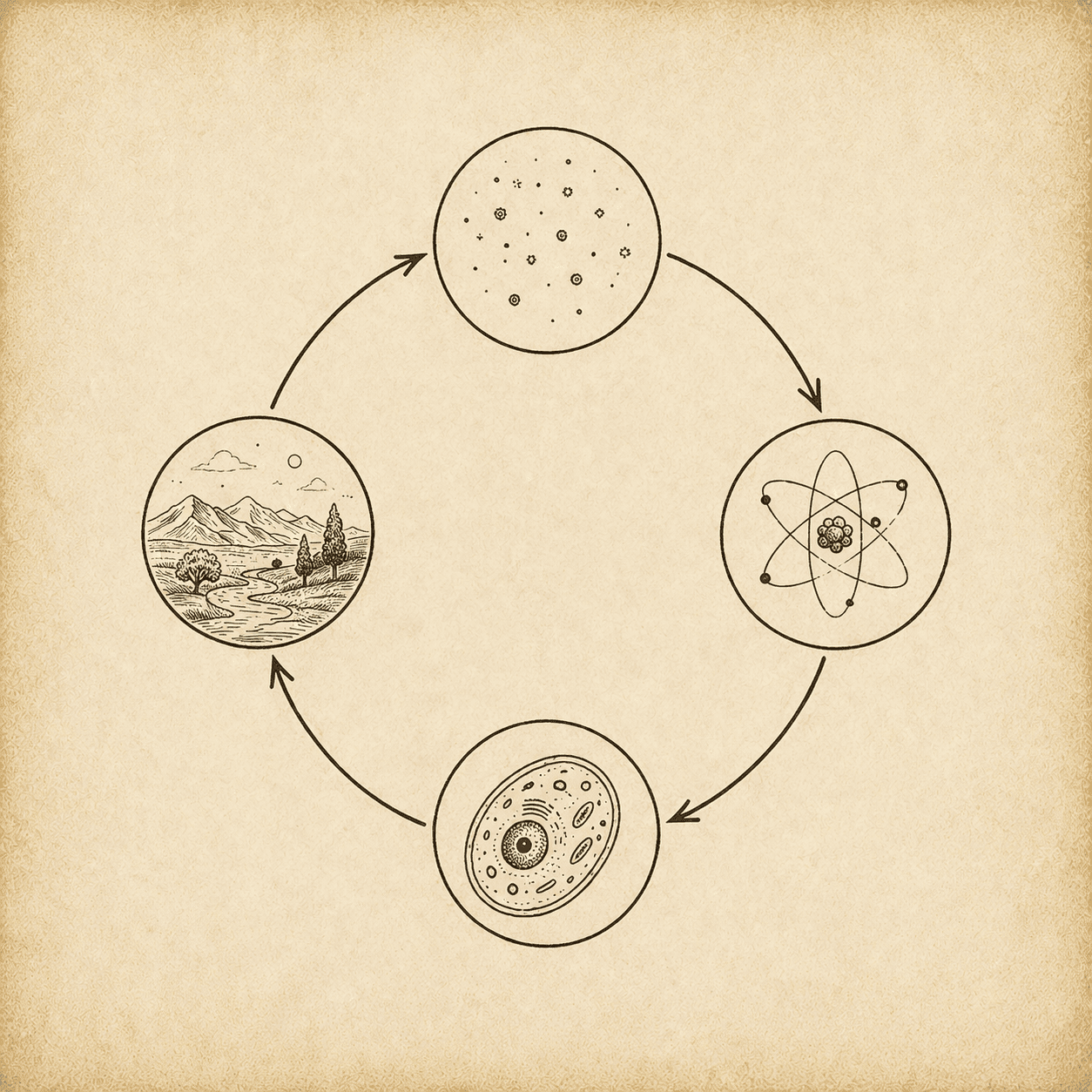
في أسفل الورقة رسمتُ عالم الكواركات: دوائر صغيرة متفاعلة. فوقه رسمتُ سهماً يصعد إلى عالم الذرات: دوائر أكبر وأكثر تعقيداً. ثم سهم آخر يصعد إلى عالم المادة المرئية: أشكال متنوعة تمثل كل ما نراه حولنا.
نظرتُ إلى الخريطة وحاولتُ أن أستخلص النمط.
كل عالم يمتلك عناصره الخاصة وقوانينه الخاصة. عالم الكواركات له جسيماته وقواه. عالم الذرات له عناصره وتفاعلاته. عالمنا المرئي له مادته وقوانينه الفيزيائية التي نعرفها. كل عالم مختلف عن الآخر، له هويته الخاصة.
لكن الشيء المشترك بين كل هذه العوالم هو أنها تعمل كلها، بكل عناصرها وقوانينها، لتحقيق نتيجة واحدة: إنتاج العالم الذي يليها.
الكواركات لا تتفاعل عبثاً. تفاعلها ينتج النيوترونات والبروتونات، وهذه بدورها تنتج الذرات. والذرات لا تتفاعل عبثاً. تفاعلها ينتج المادة المعقدة التي نراها. كل مستوى يبني المستوى التالي، والمستوى التالي يكون دائماً أكثر تعقيداً: أكثر تنوعاً في العناصر، أكثر تشعباً في القوانين.
هذا هو النمط الأول: الإنتاج. كل عالم ينتج عالماً أعقد منه.
السؤال الجوهري: من أين تعلّمت الذرات؟
توقفتُ هنا.
حدّقتُ في الورقة أمامي، في الأسهم التي رسمتُها بين العوالم، وسؤال بدأ يتشكل في ذهني. سؤال لم أفكر فيه من قبل.
الذرات، قبل أن تدخل حيز الوجود، كانت الكواركات في طور بنائها. ثم اكتمل هذا البناء، وأصبح للذرات وجود فعلي. الآن، على الذرات أن تقوم بدورها: أن تتفاعل وتنتج العالم الذي يليها.
لكن... من أين تعلّمت الذرات كيف تفعل ذلك؟
فكّرتُ في الأمر. الذرات حديثة الوجود. لم تكن موجودة، ثم وُجدت. فكيف عرفت ما يجب أن تفعله؟ كيف عرفت أن تتفاعل بهذه الطريقة بالذات لتنتج هذه المادة بالذات؟
الجواب الذي وصلتُ إليه بدا واضحاً حين فكرتُ فيه: من الكواركات. من العالم الذي أوجدها.
الكواركات لم تكتفِ بإنتاج الذرات. بل نقلت إليها أيضاً ما تحتاجه لأداء دورها. نقلت إليها، بطريقة ما، المعلومات اللازمة لتعرف كيف تتفاعل وتنتج العالم التالي.
وهذا يعني أن هناك شيئاً ينتقل بين العوالم، شيئاً أكثر من مجرد المادة. هناك معلومات.
آلية انتقال المعلومات
لكن كيف تنتقل هذه المعلومات؟
جلستُ أفكر، وعيني على الورقة أمامي. ليس هناك رسول يذهب من عالم إلى آخر ليعلّم العناصر الجديدة ما يجب أن تفعله. ليس هناك كتاب تعليمات يُسلّم للذرات حين تولد. فكيف تنتقل المعرفة؟
ثم خطرت لي فكرة.
تأملتُ في نفسي. لماذا أشعر بالجوع؟ من علّمني أن آكل؟ لا أحد جلس معي حين كنتُ رضيعاً وقال لي: "حين تشعر بهذا الإحساس في معدتك، عليك أن تبحث عن طعام." لم يحدث ذلك. ومع ذلك، أنا أعرف. جسدي يعرف. الحاجة موجودة في داخلي، مزروعة فيّ بطريقة ما.
الغرائز. هذا ما يسميها العلم. دوافع مغروسة في الكائنات الحية تدفعها للتصرف بطرق معينة دون أن يعلّمها أحد. غريزة البقاء تدفعنا للأكل والشرب. غريزة أخرى تدفعنا للتكاثر. وغرائز أخرى تدفع البشر لبناء المجتمعات وتطوير وسائل العيش.
لم يعلّمنا أحد هذه الأشياء بشكل مباشر. لكن الحاجة الكامنة في داخلنا، المزروعة في تكويننا، هي التي تحركنا.
وهنا فهمتُ الآلية.
المعلومات لا تُنقل كرسالة منفصلة. المعلومات تُنقل من خلال التكوين نفسه. حين يبني عالم الكواركات عالم الذرات، فإنه يبنيه بهيئات معينة، بخصائص معينة، بقوانين معينة. هذه الهيئات والخصائص والقوانين هي التي تجعل الذرات تتصرف بالطريقة التي تتصرف بها. الذرات لا "تعرف" بالمعنى الواعي، لكنها مبنية بطريقة تجعل سلوكها محكوماً باتجاه واحد: إنتاج العالم التالي.
تماماً كما أنني لا "أعرف" بشكل واعٍ لماذا أشعر بالجوع، لكن جسدي مبني بطريقة تجعل هذا الشعور يظهر حين أحتاج للطعام.
أضفتُ ملاحظة على الورقة أمامي: "المعلومات تنتقل عبر التكوين، لا عبر التعليم."
ثم فكرتُ في شيء آخر.
إذا كانت الكواركات تنقل للذرات المعلومات اللازمة لإنتاج العالم التالي، فهذا يعني أن الكواركات نفسها تملك هذه المعلومات. ليس فقط معلومات عالمها، بل معلومات العوالم التي ستأتي بعدها أيضاً.
لكنني توقفتُ هنا. شعرتُ بأن الفكرة أعمق مما ظننتُ في البداية.
إذا كانت الكواركات تنتج الذرات بهيئة معينة، وهذه الهيئة هي التي تمكّن الذرات من إنتاج المادة المرئية... فهذا يعني أن الكواركات حين صمّمت الذرات، كانت "تعرف" مسبقاً ما ستحتاجه الذرات لإنتاج العالم الذي بعدها.
فكّرتُ في الأمر أكثر. الكواركات لا تعرف فقط كيف تنتج الذرات. بل تعرف كيف تنتج ذرات قادرة على إنتاج المادة بالشكل الذي نراه. وهذا يعني أن معرفة الكواركات تمتد إلى ما هو أبعد من العالم الذي يليها مباشرة. تمتد إلى كل العوالم التي ستأتي بعدها.
تخيّلتُ الأمر هكذا: لو أن الكواركات لم تكن "تعرف" شيئاً عن عالم المادة المرئية، لما استطاعت أن تبني الذرات بالهيئة الصحيحة التي تمكّنها من إنتاج هذا العالم. الهيئة التي تُعطى لكل عالم ليست عشوائية، بل مصمّمة بدقة لتحقيق نتيجة بعيدة، نتيجة تمتد عبر سلسلة كاملة من العوالم.
وهذا يعني شيئاً مهماً: كل عالم يحمل في داخله معرفة كل العوالم التي ستأتي بعده، لا العالم التالي فقط. لكنه لا يعرف شيئاً عما قبله.
المعرفة تنتقل إلى الأمام فقط، لا إلى الخلف. لماذا؟ لأن المعرفة بما قبله لا تخدم مهمته. مهمته هي بناء كل ما سيأتي، وهذا ما يحمله في تكوينه.
كل عالم قائم بذاته، يحمل في داخله معلومات كل العوالم التي ستنبثق عنه، دون أن يكون معنياً بما كان قبله.
الانطلاق للمرحلة التالية
وقفتُ من مكاني ونظرتُ إلى الورقة من بعيد.
أصبحت الصورة أوضح الآن. لديّ نمط يمكنني الاعتماد عليه:
أولاً، كل عالم ينتج عالماً أعقد منه.
ثانياً، المعلومات تنتقل من كل عالم إلى العالم الذي يليه، عبر التكوين نفسه.
ثالثاً، كل عالم يعرف ما بعده لا ما قبله.
هذه الصورة الكبيرة هي المنطلق الذي سأعتمد عليه لاستكمال الرحلة. العلم التجريبي أوصلني إلى هنا، إلى عالم الكواركات. لكن العلم لم يستطع أن يرى أبعد من ذلك. لا توجد تجارب يمكنها أن تكشف ما قبل الكواركات.
هنا يأتي دور العقل.
إذا كان النمط الذي اكتشفتُه صحيحاً، فإنه يجب أن يستمر. يجب أن يكون هناك عالم قبل الكواركات أنتجها ونقل إليها معلوماتها. وقبل ذلك العالم عالم آخر. وهكذا.
السؤال الآن: إلى أين تقود هذه السلسلة؟ هل تستمر إلى ما لا نهاية؟ أم أن هناك بداية؟
طويتُ الورقة ووضعتُها في درج مكتبي. كنتُ أعرف أنني سأعود إليها كثيراً في الأيام القادمة.
بدأتُ أشعر بأنني أقترب من شيء.
ليس الإجابة بعد، لكن شيئاً مهماً على الطريق. النمط الذي اكتشفتُه، هذه الطريقة في النظر إلى الكون كعوالم متراصّة تنتج بعضها وتنقل المعلومات بينها، فتحت أمامي باباً لم أكن أراه من قبل.
الآن أستطيع أن أسأل أسئلة جديدة. أستطيع أن أتتبع السلسلة للوراء، عالماً بعد عالم، باستخدام العقل حيث توقف العلم. لا أعرف بعد أين سأصل، لكنني أعرف أن الطريق أصبح أوضح.
المرحلة التالية: الغوص في العوالم السابقة، بحثاً عن البداية.
From Quark to Matter: The Journey of Formation
I took a blank sheet of paper and a pen, and sat down to draw.
It wasn't an artistic drawing — I was trying to see the idea in front of me. I drew small circles representing quarks, then arrows connecting them, then larger circles representing what they produced. I was trying to understand the journey: How does something so small it cannot be seen transform into this world I see around me?
On the paper before me, the picture began to clarify.
Quarks are the beginning — as far as science currently knows.
Particles so infinitesimally small, far smaller than anything the eye can see even with the most powerful microscopes. They come in different types, each with its own properties. And when certain types combine with each other, something new emerges.
Some combinations produce what we call neutrons. Others produce protons. These are the two fundamental building blocks from which atoms will be constructed.
I drew that on the paper: quarks gathering together, neutrons and protons appearing.
But the atom hasn't formed yet.
Neutrons and protons cluster together at the center, in what we call the nucleus. Their number determines the type of element. An atom with one proton is hydrogen. An atom with two protons is helium. And so the elements vary according to the number of protons in their nuclei.
But the nucleus alone isn't enough. The atom isn't complete — it cannot interact with the world — until the electron arrives.
The electron is a tiny particle carrying a charge opposite to the proton's. It orbits the nucleus, surrounds it, activates it. When the electron takes its place, the atom becomes complete, ready to interact, capable of beginning its task of building the next world.
I added that to my drawing: the nucleus at the center, the electron orbiting around it.
Now the next phase begins.
Complete atoms interact with one another. They combine and separate and combine again, according to the laws that govern them. From this interaction arises the matter we know: water when hydrogen unites with oxygen, iron when its atoms cluster in a certain way, air and soil and rock and everything we see and touch.
I drew the final phase: atoms interacting, matter appearing.
I looked at the paper in front of me.
Quarks gather to produce neutrons and protons. These gather to produce a nucleus. The electron arrives and the atom is complete. Atoms interact to produce matter.
A clear chain. Each phase building the one that follows. Each world producing the next world.
But a question began pressing on my mind: How does each level know what it must do? When quarks gather, how do they "know" to produce neutrons and protons? When atoms interact, how do they "know" to produce this particular matter?
Is there something being transferred between these levels — something more than just matter and energy?
I folded the paper and set it aside. The journey from quark to matter had become clear before me. But the question of how knowledge transfers between these worlds... that was what I needed to understand now.
The Cosmic Pattern: Production and Information Transfer
The Law of Production: Every World Produces a More Complex World
On a quiet night, I sat before the small window in my rented room.
The street below was nearly empty, and the distant city lights flickered on the horizon. I took a large sheet of paper and began drawing what I had understood so far. Not a precise scientific diagram, but a map of the worlds as they had taken shape in my mind.
At the bottom of the paper I drew the world of quarks: small circles interacting. Above it I drew an arrow pointing upward to the world of atoms: larger, more complex circles. Then another arrow rising to the world of visible matter: varied shapes representing everything we see around us.
I looked at the map and tried to extract the pattern.
Every world possesses its own elements and its own laws. The world of quarks has its particles and forces. The world of atoms has its elements and interactions. Our visible world has its matter and the physical laws we know. Each world is different from the others, each with its own identity.
But what all these worlds share is that they all work — with all their elements and laws — toward a single outcome: producing the world that follows.
Quarks don't interact randomly. Their interaction produces neutrons and protons, which in turn produce atoms. And atoms don't interact randomly. Their interaction produces the complex matter we see. Each level builds the next level, and the next level is always more complex: more diverse in elements, more intricate in laws.
This is the first pattern: Production. Every world produces a more complex world.
The Essential Question: Where Did the Atoms Learn?
I stopped here.
I stared at the paper before me, at the arrows I had drawn between the worlds, and a question began forming in my mind. A question I hadn't thought of before.
Atoms, before they came into existence, were being constructed by quarks. Then that construction was complete, and atoms had actual existence. Now atoms must fulfill their role: to interact and produce the world that follows.
But... where did atoms learn how to do that?
I thought about it. Atoms are new to existence. They didn't exist, then they did. So how did they know what they were supposed to do? How did they know to interact in this particular way to produce this particular matter?
The answer I reached seemed obvious once I thought about it: From the quarks. From the world that brought them into existence.
Quarks didn't merely produce atoms. They also transferred to them what they needed to fulfill their role. They transferred, somehow, the information necessary for atoms to know how to interact and produce the next world.
And this means something is being transferred between worlds — something more than just matter. There is information.
The Mechanism of Information Transfer
But how does this information transfer?
I sat thinking, my eyes on the paper before me. There is no messenger traveling from one world to another to teach the new elements what they must do. There is no instruction manual handed to atoms when they are born. So how does knowledge transfer?
Then an idea occurred to me.
I reflected on myself. Why do I feel hunger? Who taught me to eat? No one sat with me when I was an infant and said: "When you feel this sensation in your stomach, you must look for food." That never happened. And yet, I know. My body knows. The need exists inside me, planted in me somehow.
Instincts. That's what science calls them. Drives planted in living creatures that push them to act in certain ways without anyone teaching them. The survival instinct drives us to eat and drink. Another instinct drives us to reproduce. And other instincts drive humans to build societies and develop ways of living.
No one taught us these things directly. But the need embedded within us, planted in our very constitution, is what moves us.
And here I understood the mechanism.
Information isn't transferred as a separate message. Information is transferred through the constitution itself. When the world of quarks builds the world of atoms, it builds it with certain forms, certain properties, certain laws. These forms and properties and laws are what make atoms behave the way they do. Atoms don't "know" in the conscious sense, but they are built in a way that makes their behavior directed toward one outcome: producing the next world.
Just as I don't consciously "know" why I feel hungry, but my body is built in a way that makes this feeling arise when I need food.
I added a note to the paper before me: "Information transfers through constitution, not through teaching."
Then I thought of something else.
If quarks transfer to atoms the information necessary to produce the next world, this means quarks themselves possess this information. Not just information about their own world, but information about the worlds that will come after.
But I stopped here. I felt the idea was deeper than I had first thought.
If quarks produce atoms with a specific form, and this form is what enables atoms to produce visible matter... then this means quarks, when they designed atoms, already "knew" what atoms would need to produce the world after them.
I thought about it more. Quarks don't just know how to produce atoms. They know how to produce atoms capable of producing matter in the form we see. This means the knowledge of quarks extends beyond the world immediately following them. It extends to all the worlds that will come after.
I imagined it this way: If quarks had "known" nothing about the world of visible matter, they couldn't have built atoms with the correct form that enables them to produce this world. The form given to each world isn't random — it's designed precisely to achieve a distant outcome, an outcome that extends across an entire chain of worlds.
And this means something important: every world carries within it the knowledge of all the worlds that will come after it, not just the next world. But it knows nothing about what came before.
Knowledge transfers forward only, not backward. Why? Because knowledge of what came before doesn't serve its task. Its task is to build everything that will come, and that is what it carries in its constitution.
Every world is self-contained, carrying within it the information of all the worlds that will emerge from it, without concern for what came before.
Launching into the Next Phase
I stood from my seat and looked at the paper from a distance.
The picture was clearer now. I had a pattern I could rely on:
First, every world produces a more complex world.
Second, information transfers from each world to the world that follows, through the constitution itself.
Third, every world knows what comes after it, not what came before.
This big picture is the foundation I will build on to continue the journey. Experimental science brought me here, to the world of quarks. But science couldn't see beyond that. No experiments can reveal what came before quarks.
Here is where reason takes over.
If the pattern I discovered is correct, then it must continue. There must be a world before quarks that produced them and transferred their information to them. And before that world, another world. And so on.
The question now: Where does this chain lead? Does it continue to infinity? Or is there a beginning?
I folded the paper and placed it in my desk drawer. I knew I would return to it many times in the days ahead.
I began to feel that I was approaching something.
Not the answer yet, but something important along the way. The pattern I had discovered — this way of seeing the universe as layered worlds producing one another and transferring information between them — opened a door I hadn't seen before.
Now I could ask new questions. I could trace the chain backward, world by world, using reason where science had stopped. I don't yet know where I will arrive, but I know the path has become clearer.
The next phase: Diving into the previous worlds, searching for the beginning.