اكتشاف العوالم المتراصّةDiscovering the Layered Worlds
الاكتشاف الأول: عوالم متراصّة لا عالم واحد
البحث في الفيزياء الحديثة
جلستُ في المكتبة أمام كتاب عن فيزياء الجسيمات.
الصفحات مليئة برسوم بيانية ومعادلات لا أفهم معظمها. أرقام ورموز وأسهم تشير إلى اتجاهات لا أدركها. لكنني لم أكن أبحث عن المعادلات، كنتُ أبحث عن الفكرة. وفي مكان ما بين تلك الصفحات المعقدة، وجدتُ ما شدّني.
الكتاب كان يتحدث عن الكواركات والذرات، عن تلك الوحدات الصغيرة التي يتشكل منها كل شيء. كنتُ أعرف أن الذرة موجودة، تعلمتُ ذلك في المدرسة. لكنني لم أكن أعرف أن داخل الذرة نفسها عالماً آخر، وأن هذا العالم يعمل بقواعد مختلفة تماماً عن القواعد التي نعرفها.
أخذتُ أقرأ أكثر. اكتشفتُ أن العلم حاول تفسير المادة بنظريات كثيرة، بعضها أُثبت وبعضها ظل نظرياً. قررتُ أن أركز على ما أثبتته التجربة العلمية فعلاً: الذرات والكواركات. هذان هما الأساس الذي استطاع العلم أن يفهم شيئاً حقيقياً عنه.
بدأتُ أدرس كيف تتفاعل هذه الجسيمات مع بعضها، وما القوانين التي تحكمها.
وهنا جاءت الصدمة.
الصدمة: لكل عنصر عالمه
اكتشفتُ أن الكواركات تخضع لقوانين مختلفة جذرياً عن القوانين التي تخضع لها الذرات.
ليس اختلافاً بسيطاً أو تعديلاً طفيفاً. اختلاف جذري، كأنهما ينتميان إلى عالمين مختلفين تماماً. القوى التي تحكم الكواركات، الطريقة التي تتفاعل بها، السلوك الذي تسلكه... كل ذلك يختلف عما يحدث في مستوى الذرات.
توقفتُ عن القراءة ونظرتُ أمامي.
فكرة بدأت تتشكل في ذهني، فكرة غريبة لكنها بدت منطقية. أغمضتُ عيني وحاولتُ أن أتخيل: ماذا لو فجأة ألغينا كل القوانين الفيزيائية في عالمنا واستبدلناها بقوانين مختلفة كلياً؟
تخيلتُ ذلك. تخيلتُ أن الجاذبية تختفي فجأة، أن الأجسام لم تعد تسقط للأسفل، أن الماء لم يعد يتصرف كما نعرفه، أن الضوء لم يعد ينتشر بالطريقة ذاتها. ماذا سيحدث؟
الجواب واضح: سينهار كل شيء. العالم الذي نعرفه سيتفكك ويتشكل بصورة جديدة تماماً، بناءً على القوانين الجديدة. لن يبقى شيء كما هو.
فتحتُ عيني.
إذاً، ما الذي يميّز العالم؟ ما الذي يجعله هو وليس شيئاً آخر؟ الجواب: القوانين التي يخضع لها. إذا اختلفت القوانين، اختلف العالم بأكمله.
الاستنتاج: عوالم متعددة لا عالم واحد
عدتُ إلى ما قرأتُه عن الكواركات والذرات.
إذا كانت الكواركات تخضع لقوانين مختلفة جذرياً عن الذرات، فهذا يعني... أنها تعيش في عالم مختلف.
الفكرة بدت غريبة في البداية. نحن نتحدث عن أشياء موجودة في نفس الكون، في نفس المكان بمعنى ما. لكن كلما فكرتُ فيها أكثر، كلما بدت أكثر منطقية. العالم ليس مجرد مكان، العالم هو مجموعة من القوانين التي تحكم ما فيه. وإذا كانت القوانين مختلفة، فنحن نتحدث عن عوالم مختلفة، حتى لو كانت متداخلة ومتراصّة فوق بعضها.
من تلك اللحظة، بدأتُ أنظر إلى الكون بطريقة جديدة.
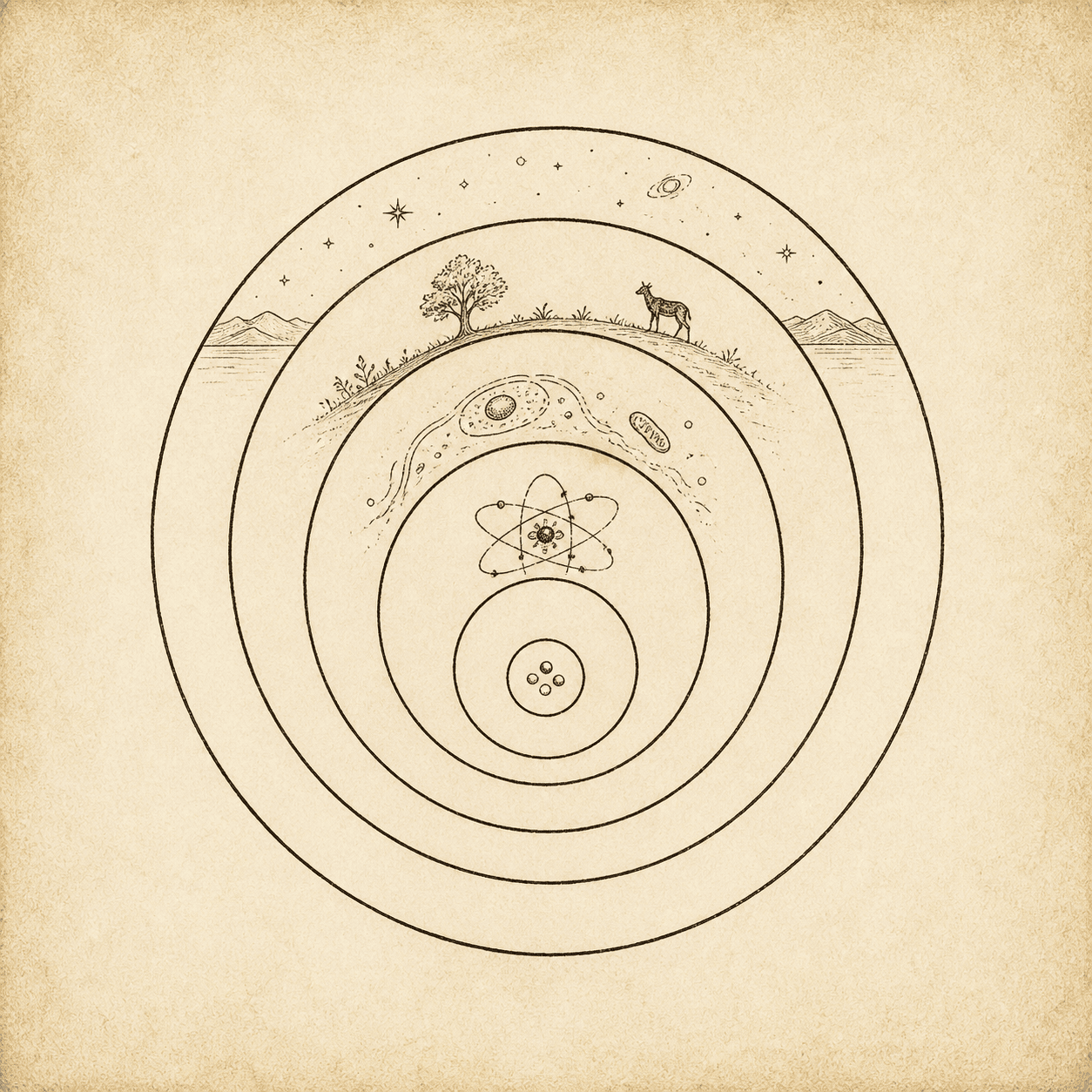
لم يعد عالماً واحداً في نظري. أصبح عوالم متعددة، متراصّة، كل منها ينتج الذي يليه. عالم الكواركات ينتج عالم الذرات. الكواركات تتفاعل مع بعضها وفق قوانينها الخاصة، فتنتج البروتونات والنيوترونات، وهذه تتجمع لتشكل نواة الذرة. ثم يأتي الإلكترون ليدور حول النواة، وبذلك تكتمل الذرة وتصبح قادرة على التفاعل لتنتج العالم الذي يليها.
وعالم الذرات بدوره ينتج عالمنا المرئي. الذرات تتفاعل مع بعضها فتنتج المادة التي نراها ونلمسها: الماء والحجر والهواء واللحم والدم.
سلسلة من العوالم، كل منها يبني الذي يليه.
وهذا يعني شيئاً مهماً: إذا كان كل عالم ينتج الذي بعده، فلا بد أن تكون هناك بداية. لا بد أن يكون هناك عالم أول بدأت منه السلسلة كلها.
أهمية هذا الاكتشاف
أغلقتُ الكتاب وجلستُ أفكر في ما اكتشفتُه.
لماذا هذا الاكتشاف مهم؟ ما الفرق الذي يصنعه في رحلة بحثي؟
الجواب بدأ يتضح: هذا الاكتشاف يوسّع منظور البحث ويجعله أكثر شمولية.
تخيلتُ الأمر هكذا: لو أردتُ أن أفهم مدينة كبيرة، يمكنني أن أدرس كل مبنى فيها على حدة، كل شارع، كل ساكن. سأجمع معلومات هائلة، تفاصيل لا حصر لها. لكنني سأحتاج وقتاً طويلاً جداً، وفي النهاية سأحتاج أن أربط كل هذه التفاصيل مع بعضها لأفهم المدينة ككل. وقد أخطئ في الربط، وقد تفوتني أشياء.
لكن ماذا لو نظرتُ إلى المدينة من أعلى؟ ماذا لو درستُها ككل، كنظام واحد، بدلاً من دراسة أجزائها؟ سأرى الصورة الكبيرة مباشرة. سأفهم كيف تعمل المدينة، ما غايتها، ما الذي يربط أجزاءها ببعض.
هذا ما يعنيه اكتشاف العوالم المتراصّة.
بدلاً من أن أغوص في تفاصيل كل جسيم وكل تفاعل وكل قانون صغير، أستطيع أن أنظر إلى كل عالم ككل. أسأل: ما الذي ينتجه هذا العالم؟ ما غايته؟ والجواب الذي وجدتُه بسيط ومذهل: كل عالم ينتج العالم الذي يليه. هذه هي النتيجة الأساسية التي تجتمع كل عناصره لتحقيقها.
عالم الكواركات بكل تعقيده وقوانينه، ماذا ينتج؟ ينتج عالم الذرات. عالم الذرات بكل تنوعه وتفاعلاته، ماذا ينتج؟ ينتج عالم المادة المرئية.
سلسلة واضحة، كل حلقة فيها تقود إلى التي تليها.
وقفتُ من مكاني في المكتبة، ونظرتُ من النافذة.
العالم الذي أراه أمامي، الأشجار والسيارات والناس والسماء، كلها نتيجة لسلسلة طويلة من العوالم التي أنتجت بعضها البعض. وإذا تتبعتُ هذه السلسلة للوراء، عالماً بعد عالم، فلا بد أن أصل في النهاية إلى البداية.
لكن السؤال الآن: ما طبيعة هذه البداية؟ وكيف أصل إليها؟
لديّ الآن منهج. لديّ طريقة للنظر إلى الكون تسمح لي بالتقدم. بدلاً من التوقف عند حدود العلم التجريبي، أستطيع أن أستخدم العقل لأتابع الرحلة.
لكن قبل أن أغوص أعمق، أحتاج أن أفهم بشكل أوضح: كيف ينتج عالم الكواركات عالم الذرات بالضبط؟
خرجتُ من المكتبة في ذلك اليوم وأنا أحمل شيئاً جديداً.
لم يكن كتاباً، بل كان طريقة جديدة للنظر إلى الوجود. الكون ليس كتلة واحدة، بل طبقات متراصّة، عوالم تبني بعضها البعض. وفي مكان ما، في أعماق هذه الطبقات، تكمن البداية.
شعرتُ للحظة بثقل ما أمامي، بضخامة الرحلة التي أنا بصددها. لكنني شعرتُ أيضاً بشيء آخر: أنني أخيراً على الطريق الصحيح.
ليلة في القرية
في تلك الفترة من حياتي، كنتُ أزور قرية جدي في الجبل بين حين وآخر.
كانت قرية صغيرة، بيوتها الحجرية القديمة متناثرة على سفح الجبل، والطرقات فيها ضيقة ومتعرجة، والحياة فيها بطيئة كأن الزمن يسير بإيقاع مختلف. كنتُ أذهب إليها حين أشعر بالحاجة إلى الهدوء، حين تصبح المدينة وضجيجها أثقل مما أحتمل.
في إحدى تلك الزيارات، خرجتُ من البيت بعد منتصف الليل.
لم أستطع النوم. الأفكار التي كانت تدور في رأسي عن العوالم المتراصّة والكواركات والذرات لم تتركني. فقررتُ أن أخرج، أن أمشي، أن أتنفس هواءً مختلفاً.
البرد كان قارساً.
لفحني حين فتحتُ الباب، برد جبلي نظيف يدخل إلى الرئتين كالماء البارد. شممتُ رائحة الأرض الرطبة، ورائحة أوراق الشجر المتساقطة، ورائحة خافتة لدخان حطب من بيت بعيد لا يزال موقده مشتعلاً.
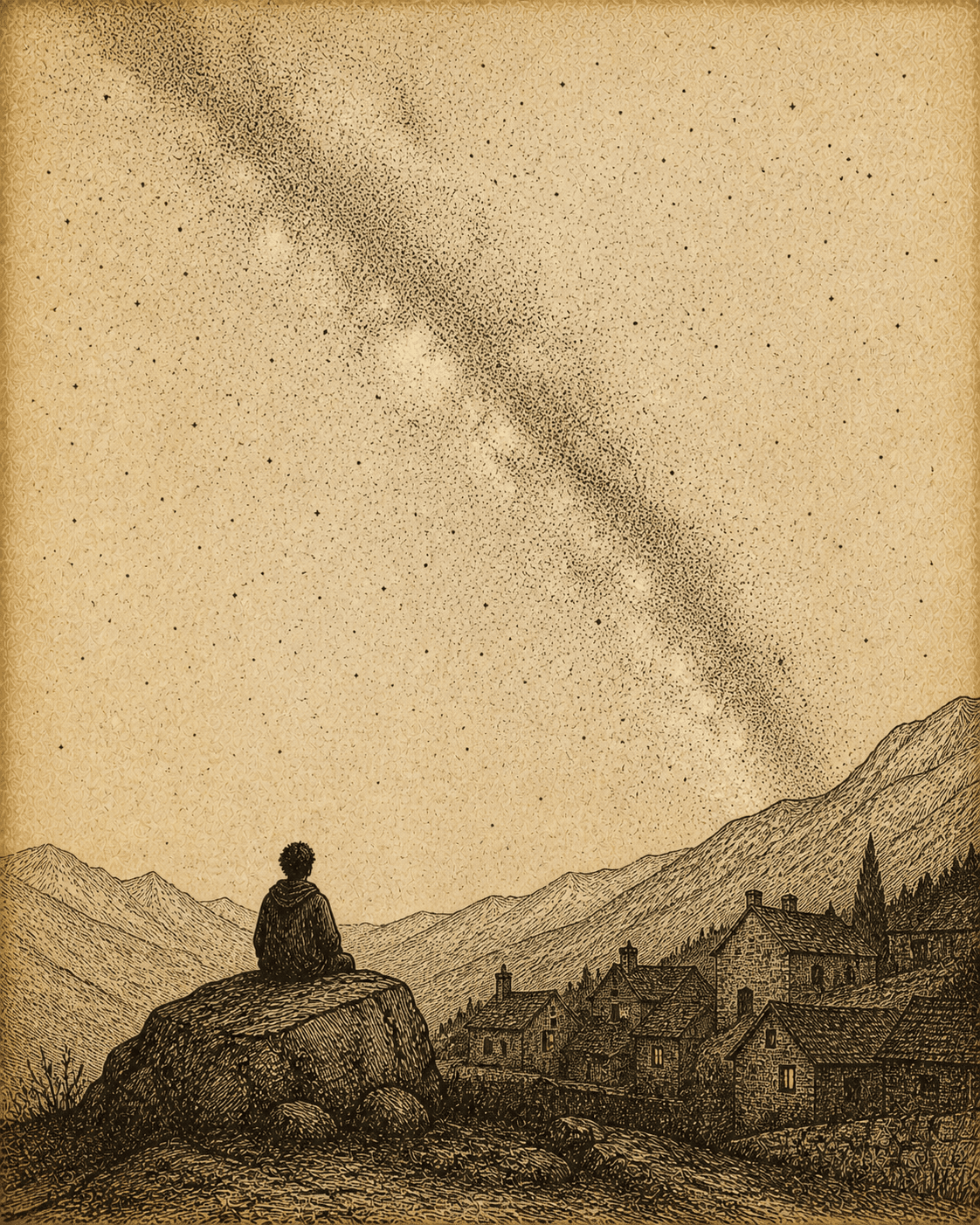
مشيتُ في الطريق الترابي الضيق حتى وصلتُ إلى حافة القرية، حيث تنتهي البيوت ويبدأ الفراغ. جلستُ على صخرة كبيرة كانت هناك، صخرة باردة وخشنة تحت يديّ، ورفعتُ رأسي إلى السماء.
ما رأيتُه جعلني أنسى البرد.
السماء كانت مليئة بالنجوم.
ليست كسماء المدينة حيث تختبئ النجوم خلف الأضواء والدخان. هنا، في هذا المكان المعزول، كانت السماء مفتوحة على مصراعيها. آلاف النجوم، ربما ملايين، متناثرة في العتمة كحبات رمل لامعة. درب التبانة يمتد كنهر من الضوء الخافت يشق السماء من طرف إلى طرف.
حدّقتُ طويلاً.
كل نقطة من تلك النقاط اللامعة شمس. بعضها أكبر من شمسنا بمئات المرات. بعضها يبعد عنا مسافات لا يستطيع العقل أن يتخيلها. الضوء الذي أراه الآن غادر بعض تلك النجوم قبل آلاف السنين، قبل أن يولد جدي وجد جدي وأجيال لا أعرف عنها شيئاً.
وأنا هنا، على هذه الصخرة، في هذه القرية الصغيرة، على هذا الكوكب الذي يبدو من هناك أصغر من حبة رمل.
شعرتُ بشيء غريب. مزيج من الضآلة والعظمة في آن واحد.
ضآلة، لأنني أمام هذا الكون الشاسع لستُ شيئاً يُذكر.
حياتي كلها، بكل ما فيها من أفراح وأحزان وأسئلة وإجابات، لا تساوي ومضة عين في عمر الكون. لو اختفيتُ الآن، لو اختفت القرية كلها، لو اختفت الأرض بأكملها، فإن تلك النجوم ستستمر في اللمعان كأن شيئاً لم يكن.
لكن في الوقت نفسه، شعرتُ بعظمة.
عظمة، لأنني الكائن الوحيد على هذه الصخرة الذي يستطيع أن ينظر إلى تلك النجوم ويسأل: من أين جاءت؟ ولماذا هي موجودة؟ وما معنى كل هذا؟ الصخرة التي أجلس عليها لا تسأل. الشجرة خلفي لا تسأل. حتى الحيوانات التي تختبئ في الظلام لا تسأل. أنا وحدي، في هذا الكون الفسيح، أحمل هذا السؤال.
ألا يعني ذلك شيئاً؟
الريح هبّت فجأة، باردة وحادة.
سمعتُ صوتها بين أغصان الشجر، صوت أشبه بالهمس، كأن الطبيعة تتحدث بلغة لا أفهمها. ارتجفتُ قليلاً، لكنني لم أرد أن أعود. كنتُ أريد أن أبقى هنا، في هذه اللحظة، مع هذا الشعور.
فكرتُ في كل ما قرأتُه في الأيام الماضية. العوالم المتراصّة، الكواركات، الذرات، السلسلة التي تبني بعضها بعضاً. كل ذلك بدا الآن صغيراً أمام هذه السماء. لكنه في الوقت نفسه بدا أكثر أهمية. لأن كل ما أراه فوقي، كل تلك النجوم والمجرات، مبني من نفس الوحدات الصغيرة التي كنتُ أقرأ عنها. نفس الكواركات، نفس الذرات، نفس القوانين.
الكون كله قطعة واحدة. وأنا جزء منه.
جلستُ هناك حتى بدأ البرد يتسلل إلى عظامي.
لم أصل إلى إجابة جديدة تلك الليلة. لكنني شعرتُ بشيء أعمق من الإجابات: شعرتُ بالاتصال. اتصال بهذا الكون الذي أحاول فهمه، اتصال بالسؤال الذي يسكنني منذ طفولتي، اتصال بشيء أكبر مني لا أستطيع تسميته بعد.
قبل أن أعود إلى البيت، وقفتُ ونظرتُ مرة أخيرة إلى السماء.
قلتُ في سرّي، لا أعرف لمن: أنا قادم. مهما كنتَ، أياً كنتَ، أنا قادم. سأتابع البحث حتى أجدك. حتى لو استغرق الأمر عمري كله.
ثم عدتُ إلى البيت، ونمتُ نوماً عميقاً لم أنمه منذ زمن.
في اليوم التالي، عدتُ إلى المدينة وإلى كتبي.
لكنني حملتُ معي شيئاً من تلك الليلة. شيئاً لا أستطيع وصفه بالكلمات، لكنه كان حاضراً في كل ما فعلتُه بعدها. ربما كان يقيناً هادئاً بأنني على الطريق الصحيح. أو ربما كان مجرد سكينة، سكينة من يعرف أن السؤال الذي يحمله يستحق الرحلة.
The First Discovery: Layered Worlds, Not a Single World
Searching Modern Physics
I sat in the library with a book on particle physics open before me.
The pages were filled with diagrams and equations I mostly couldn't understand. Numbers and symbols and arrows pointing in directions I couldn't follow. But I wasn't looking for the equations — I was looking for the idea. And somewhere between those complex pages, I found what pulled me in.
The book was discussing quarks and atoms — those tiny units from which everything is made. I already knew that atoms existed; I'd learned that in school. But I hadn't known that inside the atom itself lay another world entirely, one that operates by rules completely different from the ones we know.
I read further. I discovered that science had tried to explain matter through many theories, some proven and some still theoretical. I decided to focus on what experimental science had actually confirmed: atoms and quarks. These were the foundation that science had managed to understand something real about.
I began studying how these particles interact with each other, and what laws govern them.
That's when the shock came.
The Shock: Each Element Has Its Own World
I discovered that quarks are governed by laws radically different from those governing atoms.
Not a slight difference or a minor variation. A radical difference — as though they belonged to two entirely separate worlds. The forces governing quarks, the way they interact, the behavior they exhibit — all of it differs from what happens at the level of atoms.
I stopped reading and stared ahead.
An idea began forming in my mind — a strange idea, but one that seemed logical. I closed my eyes and tried to imagine: What if we suddenly eliminated all the physical laws in our world and replaced them with completely different ones?
I imagined it. I imagined gravity disappearing. Objects no longer falling downward. Water no longer behaving as we know it. Light no longer spreading in the same way. What would happen?
The answer was obvious: everything would collapse. The world as we know it would disintegrate and reform into something entirely new, shaped by the new laws. Nothing would remain the same.
I opened my eyes.
So what defines a world? What makes it what it is and not something else? The answer: the laws it follows. If the laws change, the entire world changes.
The Conclusion: Multiple Worlds, Not One
I returned to what I had read about quarks and atoms.
If quarks are governed by laws radically different from those of atoms, then this means... they exist in a different world.
The idea seemed strange at first. We're talking about things that exist in the same universe, in the same space in a sense. But the more I thought about it, the more logical it became. A world isn't just a place — a world is a set of laws governing what's within it. And if the laws are different, then we're talking about different worlds, even if they're interlocking and layered upon one another.
From that moment, I began seeing the universe in a new way.
It was no longer a single world in my eyes. It had become multiple worlds, layered one upon another, each producing the next. The world of quarks produces the world of atoms. Quarks interact with one another according to their own laws, producing protons and neutrons, which then gather to form the nucleus of an atom. Then the electron comes, orbiting the nucleus, and with that the atom is complete — ready to interact and produce the world that follows.
And the world of atoms, in turn, produces our visible world. Atoms interact with one another and produce the matter we see and touch: water and stone and air and flesh and blood.
A chain of worlds, each one building the next.
And this means something important: if every world produces the one after it, then there must be a beginning. There must be a first world from which the entire chain started.
The Significance of This Discovery
I closed the book and sat thinking about what I had found.
Why does this discovery matter? What difference does it make in my search?
The answer began to clarify: this discovery widens the scope of the search and makes it more comprehensive.
I imagined it this way: if I wanted to understand a large city, I could study every building individually, every street, every resident. I would gather enormous amounts of information, endless details. But it would take a very long time, and in the end I would need to connect all these details to understand the city as a whole. I might make mistakes in the connections. I might miss things.
But what if I looked at the city from above? What if I studied it as a whole, as a single system, instead of studying its parts? I would see the big picture directly. I would understand how the city works, what its purpose is, what connects its parts to one another.
That's what discovering the layered worlds means.
Instead of diving into the details of every particle and every interaction and every small law, I could look at each world as a whole. I could ask: What does this world produce? What is its purpose? And the answer I found was simple and astonishing: every world produces the world that follows it. That is the fundamental outcome toward which all its elements work together.
The world of quarks, with all its complexity and laws — what does it produce? It produces the world of atoms. The world of atoms, with all its variety and interactions — what does it produce? It produces the world of visible matter.
A clear chain, each link leading to the next.
I stood up from my seat in the library and looked out the window.
The world I could see before me — trees and cars and people and sky — all of it was the result of a long chain of worlds that had produced one another. And if I traced this chain backward, world by world, I would have to arrive at the beginning.
But the question now: What is the nature of this beginning? And how do I reach it?
I had a method now. I had a way of looking at the universe that allowed me to move forward. Instead of stopping at the limits of experimental science, I could use reason to continue the journey.
But before diving deeper, I needed to understand more clearly: How exactly does the world of quarks produce the world of atoms?
I walked out of the library that day carrying something new.
It wasn't a book — it was a new way of seeing existence. The universe is not a single mass but layered strata, worlds building upon one another. And somewhere, in the depths of those layers, lies the beginning.
For a moment, I felt the weight of what lay ahead — the enormity of the journey I was undertaking. But I also felt something else: that I was finally on the right path.
A Night in the Village
During that period of my life, I would visit my grandfather's village in the mountains from time to time.
It was a small village — old stone houses scattered along the mountainside, narrow winding roads, and a pace of life so slow it seemed as though time moved to a different rhythm. I went there when I needed quiet, when the city and its noise became more than I could bear.
During one of those visits, I stepped outside after midnight.
I couldn't sleep. The ideas swirling in my head about layered worlds and quarks and atoms wouldn't let go of me. So I decided to go out, to walk, to breathe a different kind of air.
The cold was biting.
It struck me the moment I opened the door — clean mountain cold that entered the lungs like ice water. I smelled damp earth, fallen leaves, and a faint trace of woodsmoke from a distant house whose hearth was still burning.
I walked along the narrow dirt path until I reached the edge of the village, where the houses ended and the open space began. I sat on a large rock — cold and rough beneath my hands — and lifted my head to the sky.
What I saw made me forget the cold.
The sky was filled with stars.
Not like the city sky, where stars hide behind lights and haze. Here, in this isolated place, the sky was wide open. Thousands of stars — perhaps millions — scattered across the darkness like grains of glowing sand. The Milky Way stretched like a river of faint light, cutting the sky from one end to the other.
I stared for a long time.
Every one of those glowing points was a sun. Some were hundreds of times larger than ours. Some were so far away that the mind couldn't grasp the distance. The light I was seeing now had left some of those stars thousands of years ago — before my grandfather was born, before his grandfather, before generations I knew nothing about.
And here I was, on this rock, in this small village, on a planet that from out there would look smaller than a grain of sand.
I felt something strange. A mixture of smallness and greatness at once.
Smallness, because before this vast universe, I was nothing worth mentioning.
My entire life — with all its joys and sorrows and questions and answers — didn't amount to the blink of an eye in the life of the universe. If I disappeared now, if the whole village disappeared, if the entire Earth disappeared, those stars would keep shining as though nothing had happened.
But at the same time, I felt greatness.
Greatness, because I was the only creature on this rock who could look up at those stars and ask: Where did they come from? Why do they exist? What does any of this mean? The rock I sat on doesn't ask. The tree behind me doesn't ask. Even the animals hiding in the dark don't ask. I alone, in this immense universe, carry this question.
Doesn't that mean something?
The wind came suddenly — cold and sharp.
I heard it moving through the branches, a sound like whispering, as though nature were speaking in a language I couldn't understand. I shivered, but I didn't want to go back. I wanted to stay here, in this moment, with this feeling.
I thought about everything I had read in recent days. The layered worlds. The quarks. The atoms. The chain that builds upon itself. All of it seemed small now beneath this sky. But at the same time, it seemed more important than ever. Because everything I saw above me — every star and galaxy — was built from the same tiny units I had been reading about. The same quarks. The same atoms. The same laws.
The entire universe is a single fabric. And I am part of it.
I sat there until the cold crept into my bones.
I didn't reach a new answer that night. But I felt something deeper than answers: I felt connection. Connection to this universe I was trying to understand. Connection to the question that had lived inside me since childhood. Connection to something larger than me that I couldn't yet name.
Before going back inside, I stood and looked one last time at the sky.
I said silently, not knowing to whom: I'm coming. Whatever you are, whoever you are — I'm coming. I will keep searching until I find you. Even if it takes my whole life.
Then I went home and slept more deeply than I had in a long time.
The next day, I returned to the city and to my books.
But I carried something with me from that night. Something I can't put into words, but it was present in everything I did afterward. Perhaps it was a quiet certainty that I was on the right path. Or perhaps it was simply peace — the peace of someone who knows that the question he carries is worth the journey.