الاستحالات والمفارقات - بحثاً عن البدايةImpossibilities and Paradoxes — Searching for the Beginning
الغوص في الأعماق: رحلة عكس التعقيد
تحديد المنهج العقلي
قررتُ أن أتخيل الرحلة عكسياً.
جلستُ في غرفتي، أغمضتُ عيني، وحاولتُ أن أرى ما لا يراه العلم. الكواركات هي أبعد نقطة وصل إليها العلم التجريبي. لكن إذا كان النمط الذي اكتشفتُه صحيحاً، فلا بد أن يكون هناك شيء قبلها. عالم أنتج الكواركات كما أنتجت الكواركات الذرات.
لا أملك مختبراً ولا أدوات قياس. لكنني أملك العقل. وأملك النمط الذي استخلصتُه من دراسة العوالم التي نعرفها.
المنهج بسيط: سأطبّق نفس النمط على ما لا نعرفه. إذا كان كل عالم ينتج عالماً أعقد منه، فهذا يعني أن العالم الذي قبله كان أبسط. سأتتبع هذه السلسلة للوراء، عالماً بعد عالم، محاولاً أن أفهم ما كان قبل الكواركات.
فتحتُ عينيّ وأخذتُ ورقة جديدة. حان وقت الغوص.
العالم السابق: أبسط ولكن أعلم
ما الذي نعرفه عن العالم الذي أنتج الكواركات؟
لا نعرف تفاصيله، لا نعرف شكل عناصره أو طبيعة قوانينه. لكننا نستطيع أن نستنتج بعض خصائصه من النمط الذي اكتشفناه.
أولاً، يجب أن يكون أبسط من عالم الكواركات.
هذا منطقي. إذا كان كل عالم ينتج عالماً أعقد منه، فالعكس صحيح: كل عالم يكون أبسط من العالم الذي أنتجه. عالم الكواركات معقد بقوانينه وأنواع جسيماته. العالم الذي قبله يجب أن يكون أقل تعقيداً: أقل تنوعاً في العناصر، أبسط في القوانين التي تحكمه.
ثانياً، يجب أن يملك معلومات أكثر.
هذا قد يبدو غريباً للوهلة الأولى. كيف يكون أبسط ويملك معلومات أكثر؟ لكن الأمر منطقي حين نفكر فيه بعمق.
العالم السابق للكواركات لم يكتفِ بإنتاج الكواركات فحسب. بل أنتجها بهيئة محددة بدقة، هيئة تمكّنها من إنتاج الذرات. والذرات بدورها ستُنتج بهيئة تمكّنها من إنتاج المادة المرئية. وهكذا حتى نهاية السلسلة.
هذا يعني أن العالم السابق للكواركات، حين صمّم هيئة الكواركات، كان يحمل في داخله معرفة كل ما سيأتي: ليس فقط الكواركات، بل الذرات، والمادة، وكل العوالم التي ستنبثق عنها. لو لم يكن يعرف كل ذلك، لما استطاع أن يصمم الكواركات بالهيئة الصحيحة التي تقود في النهاية إلى هذا العالم الذي نراه.
الكواركات تعرف عالمها وكل ما يليه من عوالم. لكن العالم السابق يعرف أكثر: يعرف عالمه، ويعرف عالم الكواركات، ويعرف كل ما بعده أيضاً. معلوماته أوسع وأشمل، تمتد إلى أبعد مما تمتد إليه معلومات الكواركات.
نمط الغوص: ازدياد البساطة واتساع المعرفة
رسمتُ سهماً على الورقة يتجه للأسفل، نحو الأعماق.
ثم سألتُ نفسي: ماذا لو واصلنا الغوص؟ ماذا عن العالم الذي قبل العالم السابق للكواركات؟
الإجابة تتبع نفس النمط. سيكون أبسط أيضاً، وسيملك معلومات أكثر أيضاً. أبسط في بنيته وعناصره وقوانينه، لكنه يحمل معرفة أوسع تشمل كل العوالم التي ستأتي بعده.
ومع كل خطوة نغوصها للأسفل، يتكرر النمط:
- البساطة تزداد - المعلومات تتسع
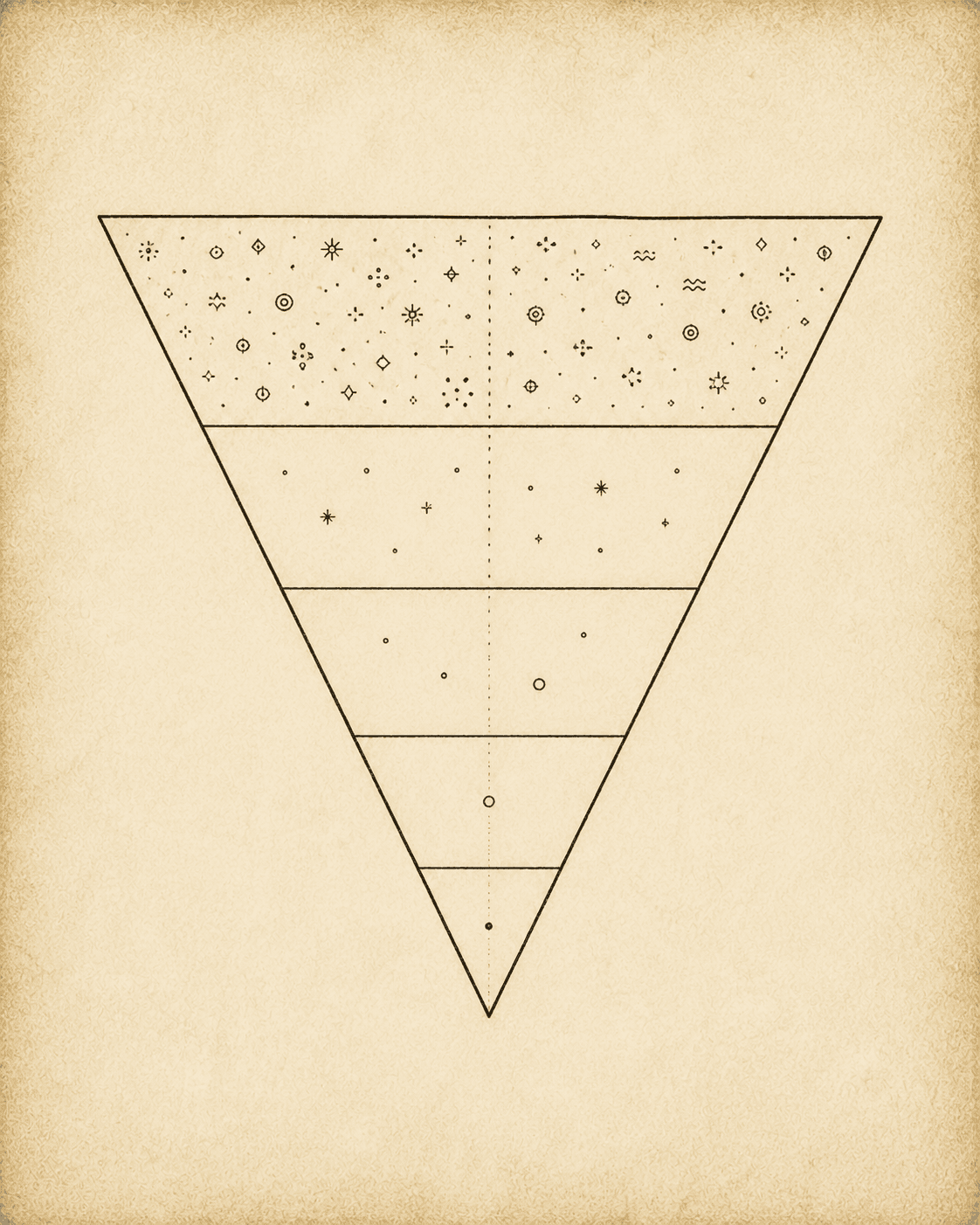
تخيلتُ الأمر كهرم مقلوب. في القمة، حيث نحن، التعقيد في أعلى درجاته: عالمنا المرئي بكل تنوعه وتشعبه. كلما نزلنا، يضيق الهرم: أقل تعقيداً، أقل تنوعاً، أبسط في البنية. لكن في المقابل، المعرفة المختزنة تتسع: كل مستوى يعرف أكثر مما يعرفه المستوى الذي فوقه.
كتبتُ على الورقة:
- "كلما غصنا أعمق: البنية أبسط، المعرفة أوسع"
السؤال الجوهري
توقفتُ ونظرتُ إلى ما كتبتُ.
النمط واضح. لكن سؤالاً كبيراً بدأ يلحّ عليّ: إلى أين يقود هذا الغوص؟
إذا كانت السلسلة تستمر، عالم بعد عالم، كل واحد أبسط من الذي يليه وأغنى بالمعلومات... فمتى تنتهي؟ هل هناك عالم أول؟ أم أن السلسلة تمتد إلى ما لا نهاية؟
حاولتُ أن أتخيل سلسلة لا نهائية. عوالم لا حصر لها، كل منها ينتج الذي يليه، بلا بداية. الفكرة بدت غريبة، لكنني لم أستطع أن أرفضها مباشرة. ربما الكون هكذا فعلاً؟ ربما لا توجد بداية؟
لكن شيئاً ما في هذه الفكرة لم يكن مريحاً. شعرتُ بأن هناك مشكلة ما، لكنني لم أستطع أن أحددها بوضوح بعد.
قررتُ أن أفكر في الأمر بعمق أكبر.
هل يمكن فعلاً أن تستمر السلسلة إلى ما لا نهاية؟ أم أن هناك استحالة منطقية في هذا الافتراض؟
وإذا كانت السلسلة يجب أن تنتهي، فما طبيعة ذلك العالم الأول؟ كيف يمكن لشيء أن يكون أول السلسلة دون أن يكون قد أنتجه شيء قبله؟
وضعتُ القلم جانباً.
الأسئلة أصبحت أصعب الآن. لم أعد أتحدث عن فيزياء وجسيمات، بل عن أسئلة أعمق: عن طبيعة الوجود نفسه، عن البداية والنهاية، عن ما يمكن أن يكون وما يستحيل أن يكون.
شعرتُ بأنني على حافة شيء كبير. شيء سيغيّر طريقة نظري إلى كل شيء.
لكن قبل أن أصل إلى هناك، كان عليّ أن أواجه الاستحالات.
الاستحالة الأولى: سلسلة لا يمكن أن تكون لا نهائية
السؤال الذي تركتُه معلقاً في ذهني لم يتركني.
هل يمكن أن تستمر سلسلة العوالم إلى ما لا نهاية؟ عالم ينتج عالماً، وذاك ينتج آخر، وهكذا بلا بداية؟ الفكرة بدت ممكنة في البداية. لكن كلما فكرتُ فيها أكثر، كلما شعرتُ بأن هناك خطأً ما.
قررتُ أن أختبر الفكرة بتجربة ذهنية بسيطة.
حاولتُ أن أتخيل أنني سأعدّ تنازلياً من اللانهاية إلى الرقم واحد.
أغمضتُ عيني وقلتُ لنفسي: سأبدأ من اللانهاية، ثم أنزل رقماً رقماً حتى أصل إلى واحد. بدا الأمر بسيطاً كفكرة. لكن حين حاولتُ أن أبدأ فعلاً، وقفتُ عاجزاً.
من أين أبدأ؟
اللانهاية ليست رقماً. لا أستطيع أن أقول "سأبدأ من هنا" لأنه لا يوجد "هنا" في اللانهاية. لا توجد نقطة أستطيع أن أضع قدمي عليها وأقول: هذه هي البداية، من هنا سأنطلق. اللانهاية تعني بالضبط أنه لا توجد بداية.
جلستُ أفكر في هذا.
لو كانت السلسلة لا نهائية فعلاً، لا نهائية بالمعنى الحقيقي للكلمة، فهذا يعني أنها بلا بداية. وإذا كانت بلا بداية، فكيف بدأت؟ كيف وصلنا إلى هنا، إلى هذه اللحظة، إلى هذا العالم؟
فكّرتُ في الأمر بطريقة أخرى.
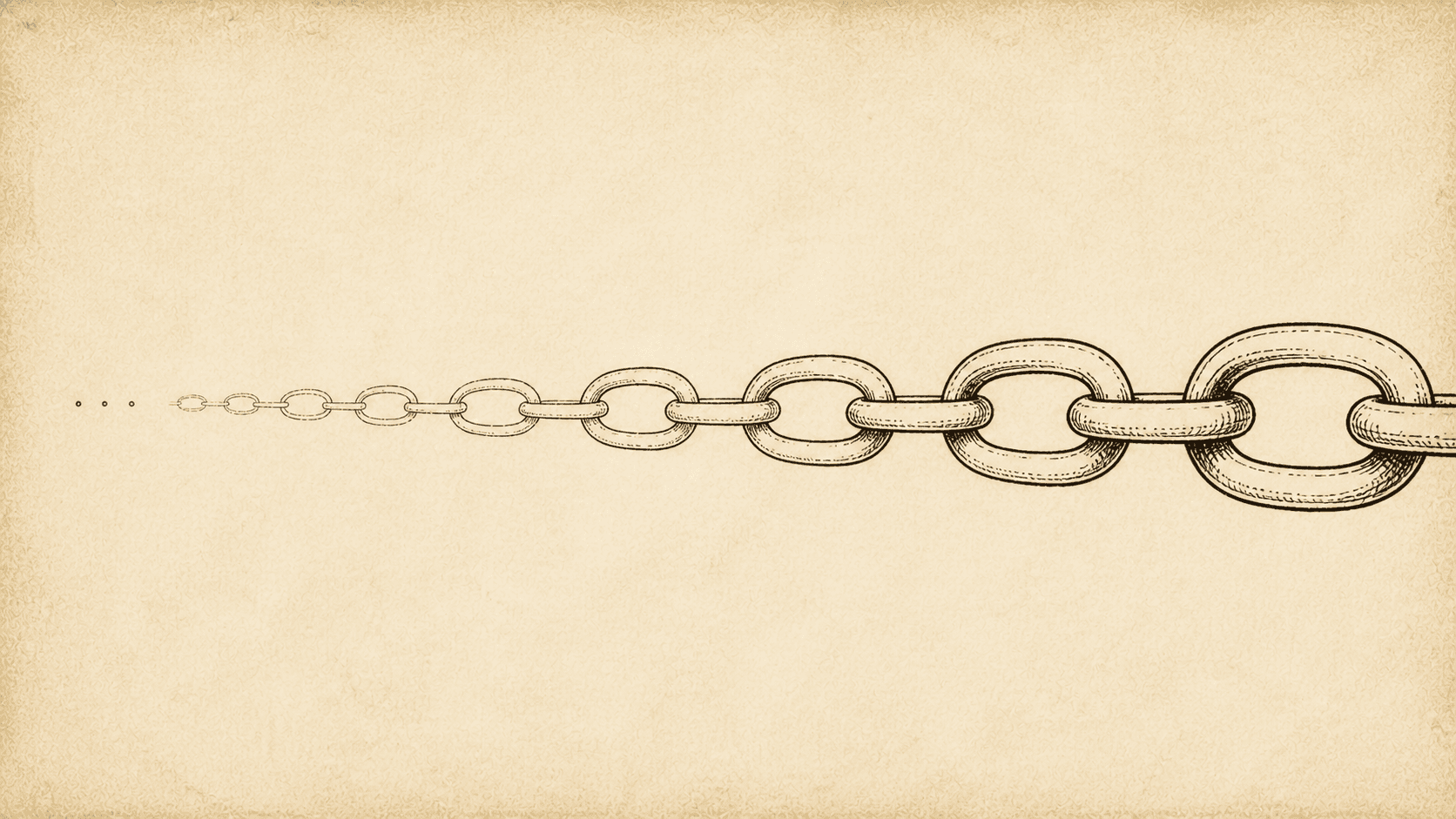
لنفترض أن سلسلة العوالم لا نهائية فعلاً. هذا يعني أن هناك عدداً لا نهائياً من العوالم التي كان يجب أن تُنتَج قبل أن يصل الدور إلى عالمنا. عدد لا نهائي. ليس مليار عالم، ولا تريليون، بل عدد لا ينتهي.
لكن العدد الذي لا ينتهي لا يمكن أن يُجتاز.
لو وقفتُ في نقطة ما وقلتُ: سأمشي عدداً لا نهائياً من الخطوات، ثم سأصل إلى هناك... فلن أصل أبداً. لأن "عدداً لا نهائياً من الخطوات" يعني أنني سأظل أمشي إلى الأبد دون أن أبلغ الوجهة. هذه هي طبيعة اللانهاية: لا يمكن اجتيازها، لا يمكن إكمالها، لا يمكن الوصول إلى نهايتها.
وإذا كان الأمر كذلك، فكيف وصلت سلسلة العوالم إلينا؟
الجواب بدا واضحاً الآن.
إذا كانت السلسلة لا نهائية، فهي لم تبدأ أصلاً. وإذا لم تبدأ، فلا شيء كان سيُنتَج. لا الكواركات، ولا الذرات، ولا المادة، ولا نحن. لأن الوصول إلى أي نقطة يتطلب أن تكون هناك بداية انطلقنا منها.
لكننا هنا. العالم موجود. أنا موجود، أفكر في هذا السؤال. وهذا يعني أن السلسلة وصلت إلى هنا فعلاً. وإذا وصلت، فهي ليست لا نهائية. لا يمكن أن تكون.
كتبتُ على ورقة أمامي:
"السلسلة اللانهائية لا بداية لها. وما لا بداية له لا يمكن أن يتقدم خطوة واحدة. لو كانت سلسلة العوالم لا نهائية، لما بدأت أصلاً، ولما وصلت إلى أي نقطة، ولما كان هناك شيء على الإطلاق."
نظرتُ إلى ما كتبتُ وشعرتُ بثقة لم أشعر بها منذ وقت.
هذه ليست نظرية أو احتمالاً. هذا برهان. استحالة منطقية لا مفر منها. السلسلة يجب أن تكون لها بداية. يجب أن يكون هناك عالم أول.
لكن هذا الاكتشاف، رغم وضوحه، فتح أمامي سؤالاً آخر.
إذا كان هناك عالم أول، فما طبيعته؟ كل عالم نعرفه أُنتج من عالم قبله. هذا هو النمط. فكيف يمكن للعالم الأول أن يكون موجوداً دون أن ينتجه شيء؟
شعرتُ بأنني حللتُ مشكلة لأجد نفسي أمام مشكلة أخرى. لكنني كنتُ متأكداً من شيء واحد: السلسلة لها بداية. هذا مؤكد. أما طبيعة هذه البداية، فهذا ما يجب أن أفهمه الآن.
الاستحالة الثانية: لا وجود من العدم
وصلتُ إلى نتيجة واضحة: السلسلة لها بداية.
لكن هذه النتيجة فتحت أمامي سؤالاً صعباً. إذا كان هناك عالم أول، فكيف وُجد؟ كل عالم نعرفه أُنتج من عالم قبله. هذا هو النمط الذي اكتشفتُه. فكيف يمكن للعالم الأول أن يكون موجوداً دون أن ينتجه شيء؟
هل يمكن أن يكون قد وُجد من تلقاء نفسه؟ من العدم؟
قبل أن أجيب، توقفتُ عند شيء لاحظتُه في قراءاتي العلمية.
العلم يتعامل مع الكوارك على أنه "عنصر أولي". أي أنه الوحدة الأساسية التي لا تتكون من شيء آخر، كيان قائم بذاته. لكن حين سألتُ نفسي: لماذا يعتقد العلم ذلك؟ وجدتُ أن السبب بسيط: لأن العلم لم يستطع حتى الآن أن يرصد ما قبل الكوارك. لا توجد أدوات قادرة على كشف ما هو أعمق.
هذا ليس دليلاً على أن الكوارك عنصر أولي فعلاً. هذا مجرد اعتراف بحدود المعرفة الحالية.
والدليل على ذلك أن الموقف نفسه تكرر من قبل. لفترة طويلة من تاريخ العلم، كانت الذرة تُعتبر العنصر الأولي. الكلمة نفسها، "ذرة"، تعني في أصلها اليوناني "ما لا يمكن تقسيمه". اعتقد العلماء أنها الوحدة الأساسية التي لا تتكون من شيء. ثم جاء يوم اكتُشف فيه أن الذرة نفسها مركّبة من أجزاء أصغر: بروتونات ونيوترونات وإلكترونات. وهذه بدورها اكتُشف أنها مركّبة من كواركات.
ما كان يُعتبر "أولياً" تبيّن أنه ليس كذلك. الأولية كانت مجرد جهل بما قبله، لا حقيقة مثبتة.
لكن دعني أفترض، جدلاً، أن هناك شيئاً أولياً فعلاً. شيئاً لم يُنتجه شيء قبله، بل وُجد من تلقاء نفسه.
هل هذا ممكن؟
نظرتُ إلى الكوارك كما يصفه العلم. له خصائص محددة: كتلة معينة، شحنة معينة، سلوك معين. له هيئة، حتى لو كانت هيئة بسيطة جداً. ليس "لا شيء"، بل "شيء" له صفات.
وهنا السؤال: من أين جاءت هذه الصفات؟
إذا قلنا إن الكوارك وُجد من العدم، فنحن نقول إن هذه الكتلة المحددة، وهذه الشحنة المحددة، وهذا السلوك المحدد، كلها ظهرت من لا شيء. بلا سبب، بلا مصدر، بلا شيء حدّدها.
لكن العدم لا يملك شيئاً. العدم ليس "شيئاً فارغاً"، بل هو غياب كل شيء. لا توجد فيه معلومات، لا توجد فيه إمكانيات، لا يوجد فيه ما يمكن أن يحدد أي صفة. فكيف يمكن لشيء له صفات محددة أن يخرج من لا شيء؟
فكّرتُ في الأمر من زاوية أخرى.
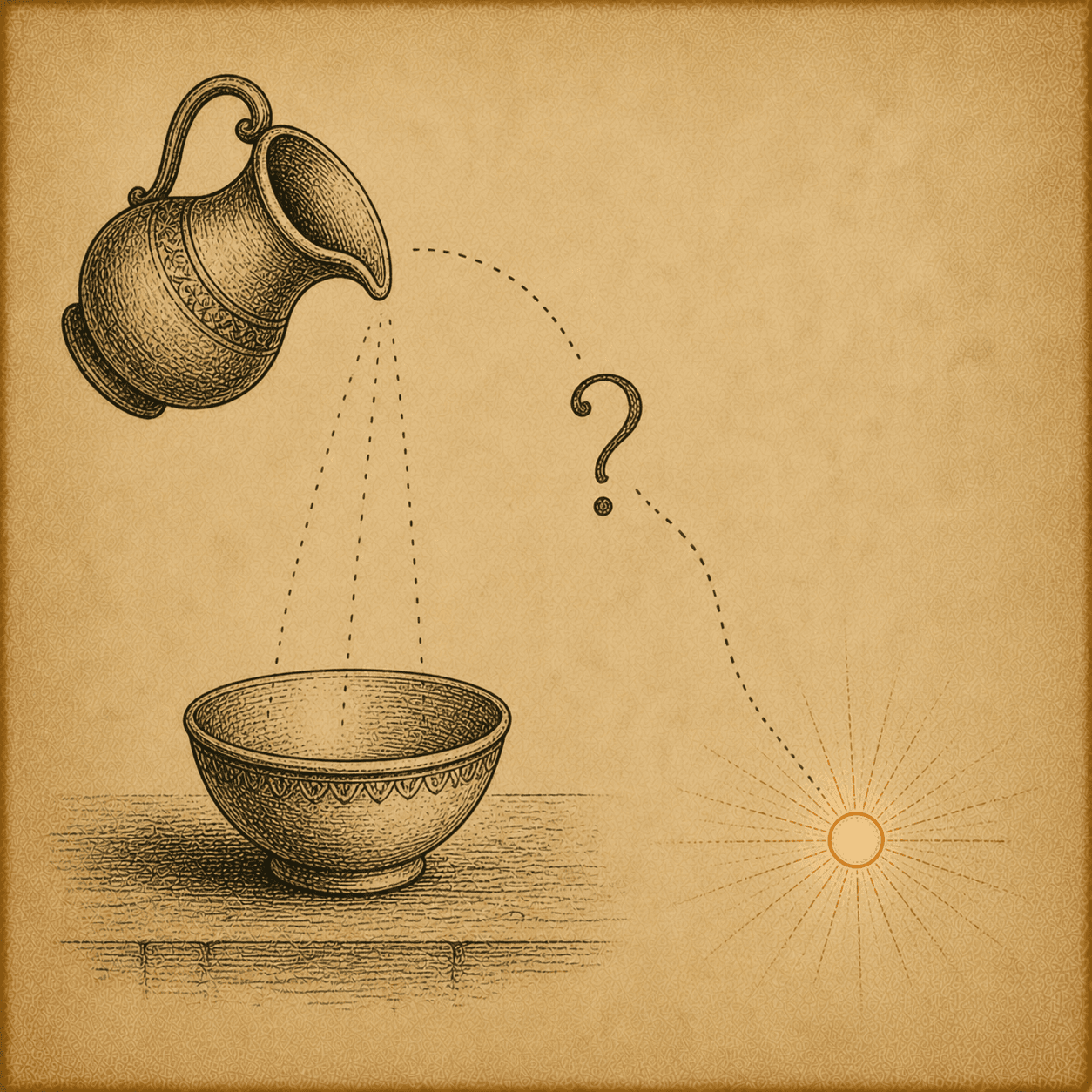
تخيّلتُ أنني أمام ورقة بيضاء فارغة تماماً. ثم فجأة، ظهر عليها رسم معقد: خطوط وألوان وأشكال. لم يرسمه أحد، لم تلمسه يد، لم يكن هناك قلم أو فرشاة. ظهر وحده من العدم.
هل هذا ممكن؟
كل عقل سليم سيقول: لا. الرسم يحتاج إلى راسم. الشكل يحتاج إلى من شكّله. الصفات المحددة تحتاج إلى من حدّدها. هذه ليست قاعدة علمية فقط، بل بديهية عقلية. نحن نعرفها بالفطرة قبل أن نتعلم أي علم.
في عالمنا المألوف، يستحيل أن نجد إنساناً لم يُولد من أحد. يستحيل أن نجد بيتاً لم يبنه أحد. يستحيل أن نجد كتاباً لم يكتبه أحد. كل شيء له هيئة محددة يشير بالضرورة إلى مصدر أعطاه هذه الهيئة.
عدتُ إلى السؤال الأصلي.
الكوارك، أو أي عنصر آخر نفترض أنه "أولي"، له هيئة. له طاقة. له خصائص محددة. وكل شيء له خصائص محددة لا يمكن أن يكون قد أوجد نفسه. لماذا؟ لأنه قبل أن يوجد، لم يكن شيئاً. وما ليس شيئاً لا يملك القدرة على فعل أي شيء، بما في ذلك إيجاد نفسه.
هذه هي الاستحالة الثانية: يستحيل أن يوجد شيء من العدم.
كل كيان يمتلك هيئة أو طاقة أو أي شكل من أشكال الوجود المحدد، لا بد أن يكون مسبوقاً بشيء أوجده. شيء يملك المعلومات اللازمة لتحديد هذه الهيئة وهذه الطاقة وهذه الخصائص.
كتبتُ على ورقتي:
"ما لا وجود له لا يملك القدرة على إيجاد نفسه. وما له هيئة محددة لا بد أن يكون قد حُدّدت له من مصدر يملك معلومات هذه الهيئة."
نظرتُ إلى ما كتبتُ، ثم نظرتُ إلى ما كتبتُه في الفصل السابق عن الاستحالة الأولى.
لديّ الآن استحالتان واضحتان:
- الأولى: السلسلة لا يمكن أن تكون لا نهائية، إذاً لا بد من بداية. - الثانية: لا شيء يمكن أن يوجد من العدم، إذاً كل شيء يحتاج لما أوجده.
لكن... ألا تتعارض هاتان الاستحالتان؟
إذا كانت السلسلة يجب أن تنتهي عند بداية، وفي الوقت نفسه لا شيء يمكن أن يوجد بنفسه... فكيف يمكن أن يوجد العالم الأول؟
شعرتُ بأنني أمام جدار. لكنني كنتُ متأكداً أن الجدار ليس نهاية الطريق. كان هناك شيء لم أفهمه بعد، شيء سيفتح الباب.
المفارقة: حين تتصادم الاستحالتان
وقفتُ حائراً أمام ما توصلتُ إليه.
أمامي استحالتان، كلتاهما تبدو صحيحة، وكلتاهما تناقض الأخرى. كيف يمكن للاثنتين أن تكونا صحيحتين معاً؟
الاستحالة الأولى تقول: السلسلة لا يمكن أن تمتد إلى ما لا نهاية.
هذا واضح. اللانهاية لا بداية لها، وما لا بداية له لا يمكن أن يتقدم خطوة واحدة. لو كانت سلسلة العوالم لا نهائية، لما وصلت إلى أي نقطة، ولما كان هناك شيء الآن. لكن الأشياء موجودة. أنا موجود. إذاً السلسلة ليست لا نهائية. إذاً لا بد أن تنتهي عند بداية. لا بد أن يكون هناك عالم أول.
الاستحالة الثانية تقول: لا شيء يمكن أن يوجد من العدم.
هذا أيضاً واضح. كل شيء له هيئة محددة، له صفات معينة، له وجود بشكل ما، لا بد أن يكون قد أوجده شيء قبله. شيء يملك المعلومات اللازمة لتحديد هذه الهيئة وهذه الصفات. العدم لا يملك شيئاً، فلا يمكن أن يُنتج شيئاً.
لكن إذا جمعتُ الاستحالتين معاً، وجدتُ نفسي في مأزق.
الأولى تقول: لا بد من عالم أول. الثانية تقول: لا شيء يمكن أن يوجد بنفسه دون أن يُوجده شيء قبله.
فكيف يمكن أن يوجد عالم أول؟
إذا كان "أول"، فهذا يعني أنه ليس قبله شيء. وإذا لم يكن قبله شيء، فمن أوجده؟ لا شيء يمكن أن يوجد نفسه. هذا ما أثبتته الاستحالة الثانية. فهل العالم الأول استثناء من هذه القاعدة؟
جلستُ أفكر.
لا، لا يمكن أن يكون استثناءً اعتباطياً. القواعد المنطقية لا تقبل استثناءات بلا سبب. إذا قلنا إن العالم الأول "وُجد من تلقاء نفسه"، فنحن لم نحل المشكلة، بل تجاهلناها. نحن نقول إن هناك شيئاً له هيئة وصفات ظهر من العدم، وهذا بالضبط ما أثبتنا استحالته.
شعرتُ لوهلة بأنني وصلتُ إلى طريق مسدود.
استحالتان متعارضتان، ولا مخرج ظاهر. السلسلة يجب أن تنتهي، لكن ما تنتهي إليه لا يمكن أن يكون قد أوجد نفسه. كأنني أقول: لا بد أن يوجد باب، لكن لا يمكن لأي باب أن يوجد.
لكنني توقفتُ.
هناك شيء في هذا التناقض لم أنتبه إليه. شيء يختبئ في صياغة المشكلة نفسها. الاستحالة الثانية تقول إن كل شيء له "هيئة" أو "طاقة" أو "صفات محددة" لا يمكن أن يوجد بنفسه. هذا صحيح. لكن ماذا لو كان هناك شيء... ليس له هيئة؟
الفكرة بدت غريبة في البداية. كل ما أعرفه له شكل ما، له وجود محدد بطريقة ما. لكن ماذا لو كانت "البداية" التي أبحث عنها مختلفة جذرياً عن كل ما أعرفه؟
أخذتُ نفساً عميقاً.
ربما المشكلة ليست في الاستحالتين، بل في افتراضي أن العالم الأول يشبه العوالم التي أعرفها. ربما هو شيء آخر تماماً. شيء لا تنطبق عليه الاستحالة الثانية، لأنه لا يملك الخصائص التي تجعل هذه الاستحالة سارية.
إذا كانت الاستحالة الثانية تقول: "كل ما له هيئة يحتاج لمن أوجده"، فالمخرج الوحيد هو أن يكون العالم الأول بلا هيئة. بلا طاقة بالشكل الذي نعرفه. بلا صفات مادية تحتاج لمن يحددها.
لكن ما الذي يمكن أن يكون موجوداً... وليس له هيئة؟
كتبتُ السؤال على ورقتي ونظرتُ إليه طويلاً. شعرتُ بأنني على حافة شيء. الجواب قريب، أستطيع أن أحسّ به، لكنني لم أمسكه بعد.
قررتُ أن أتابع التفكير. المفارقة ليست طريقاً مسدوداً، بل لغز يحتاج إلى حل. والحل موجود، أنا متأكد من ذلك. عليّ فقط أن أجده.
حل المفارقة: ما وراء الهيئة والطاقة
ظللتُ أفكر في السؤال الذي تركتُه معلقاً: ما الذي يمكن أن يكون موجوداً وليس له هيئة؟
ثم فجأة، ومضت فكرة في ذهني.
عدتُ إلى صياغة الاستحالة الثانية بدقة.
ما الذي تقوله بالضبط؟ تقول إن كل كيان يمتلك هيئة، أو طاقة، أو أي شكل من أشكال التركيب، لا يمكن أن يكون موجوداً بذاته. لا بد أن يكون مسبوقاً بشيء أوجده وحدّد له هذه الهيئة وهذه الطاقة وهذا التركيب.
هذا صحيح. لكن لاحظتُ شيئاً مهماً في هذه الصياغة.
الاستحالة لا تقول إن "كل شيء" يحتاج لمن أوجده. تقول إن "كل شيء له هيئة أو طاقة أو تركيب" يحتاج لمن أوجده. الشرط هو امتلاك هذه الخصائص. فماذا لو وُجد شيء لا يمتلكها؟
تخيّلتُ الأمر.
كل العوالم التي أعرفها، من الكواركات إلى المادة المرئية، لها خصائص محددة. لها أشكال من الوجود يمكن وصفها: جسيمات، طاقة، كتلة، شحنة، حركة. كل هذه الأشياء تحتاج لمن حدّدها. هذا واضح.
لكن ماذا لو كانت البداية التي أبحث عنها مختلفة جذرياً؟
ماذا لو كانت خالية من كل هذه الخصائص؟ لا هيئة، لا طاقة بالمعنى الذي نعرفه، لا تركيب، لا شكل محدد يحتاج لمن يحدده؟
عندها... لن تنطبق عليها الاستحالة الثانية.
شعرتُ بأن شيئاً بدأ يتضح.
الاستحالة الثانية تمنع وجود شيء "مادي" أو "طاقوي" بذاته. تمنع وجود شيء له صفات محددة دون مصدر حدّدها. لكنها لا تمنع وجود شيء آخر تماماً، شيء لا تنطبق عليه هذه الأوصاف أصلاً.
وهنا يكمن الحل.
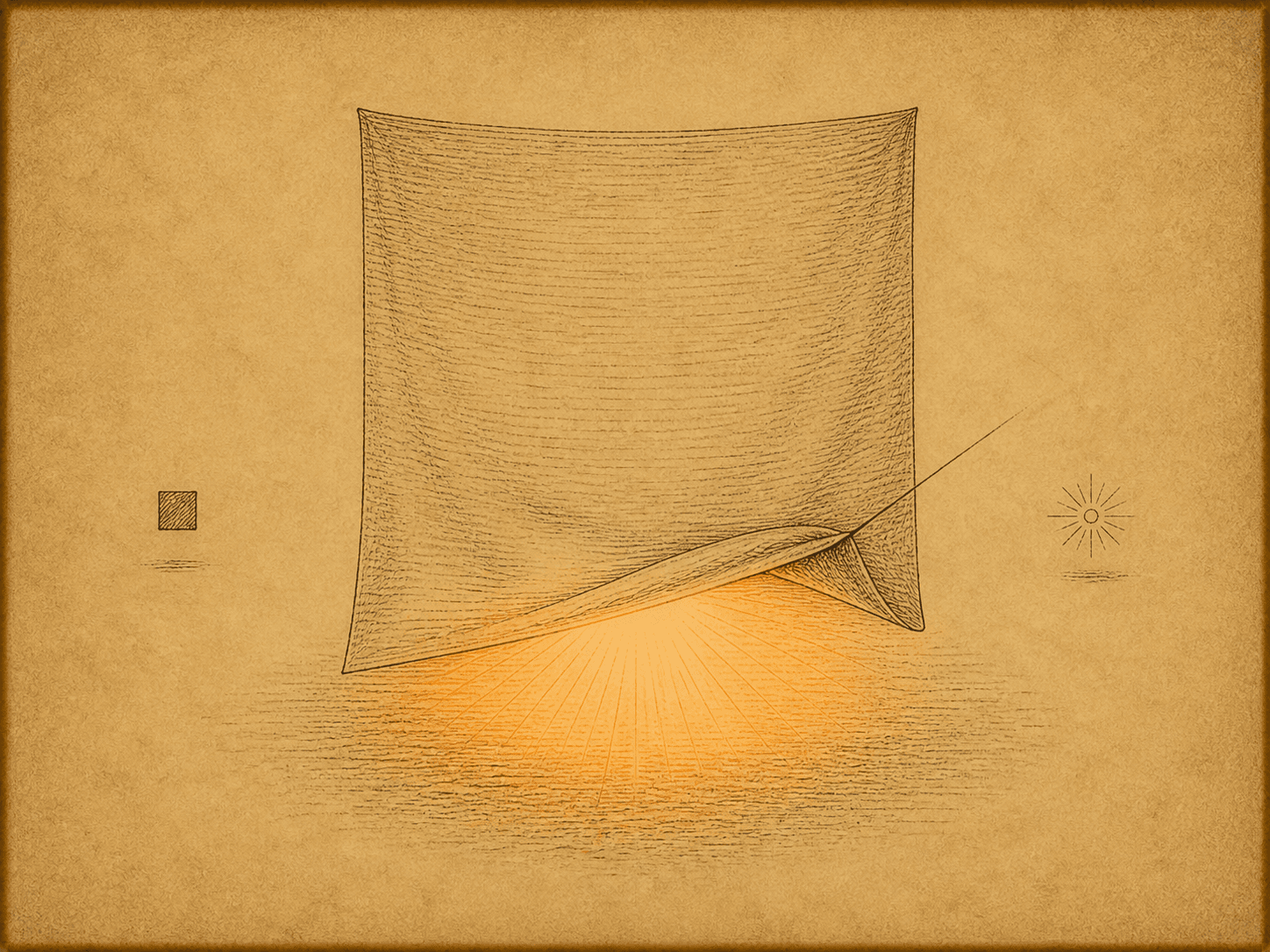
العالم الأول، البداية الحقيقية لسلسلة العوالم، ليس عالماً بالمعنى الذي أعرفه. ليس له هيئة تحتاج لمن يشكّلها. ليس له طاقة تحتاج لمن يمنحها. ليس له تركيب يحتاج لمن يركّبه. هو شيء مغاير تماماً لكل ما يأتي بعده.
بهذا الفهم، تنحل المفارقة.
دعني أعيد صياغة ما توصلتُ إليه.
الاستحالة الأولى تقول: السلسلة يجب أن تنتهي عند بداية. هذا صحيح، ويبقى صحيحاً.
الاستحالة الثانية تقول: كل ما له هيئة وطاقة يحتاج لمن أوجده. هذا أيضاً صحيح، ويبقى صحيحاً.
لكن الاستحالة الثانية لا تمنع وجود البداية، بل تحدد طبيعتها. تقول لنا إن هذه البداية لا يمكن أن تكون شيئاً له هيئة أو طاقة. يجب أن تكون شيئاً آخر.
الاستحالتان لا تتعارضان. الأولى تُثبت وجود البداية، والثانية تكشف عن طبيعتها.
كتبتُ على ورقتي:
"السلسلة تنتهي عند بداية حقيقية. لكن هذه البداية ليست عالماً كالعوالم الأخرى. ليس لها هيئة ولا طاقة ولا تركيب. هي شيء مختلف جذرياً، شيء لا تنطبق عليه الاستحالة الثانية، لأنه لا يملك الخصائص التي تجعل هذه الاستحالة سارية."
نظرتُ إلى ما كتبتُ وشعرتُ براحة غريبة.
المفارقة انحلّت. الطريق المسدود انفتح. لكن السؤال الآن أصبح مختلفاً: إذا كانت البداية ليس لها هيئة ولا طاقة... فما هي؟ ما طبيعة هذا الشيء الذي يمكن أن يكون موجوداً دون أن يكون مادياً؟
تذكّرتُ شيئاً.
في رحلتي عبر العوالم، لاحظتُ نمطاً: كلما غصنا أعمق في السلسلة، ازدادت البساطة في الهيئات والتركيب، وازداد اتساع المعلومات. العالم السابق أبسط من الذي يليه، لكنه يحمل معرفة أوسع.
إذا تابعنا هذا النمط حتى النهاية، حتى البداية الحقيقية، فماذا نجد؟
نجد أن الهيئات والتركيب تضمحل تماماً. تصل إلى الصفر. لا يبقى شيء مادي على الإطلاق.
لكن في المقابل، المعلومات تبلغ حدها الأقصى. تصل إلى الذروة.
فهل يمكن أن تكون البداية... معلومات فقط؟
شعرتُ بأنني أقترب من شيء كبير. شيء لم أتخيله حين بدأتُ هذه الرحلة.
وصلتُ إلى نقطة فاصلة.
القسم الذي قطعتُه حتى الآن كان رحلة في الاستحالات والمفارقات. أثبتُّ أن السلسلة لها بداية، وأثبتُّ أن هذه البداية لا يمكن أن تكون شيئاً مادياً. الآن أقف على عتبة سؤال جديد: ما طبيعة هذه البداية؟ ما الذي يمكن أن يكون موجوداً دون هيئة ولا طاقة، ومع ذلك يحمل كل المعلومات اللازمة لإنتاج كل العوالم؟
هذا ما سأحاول فهمه في المرحلة القادمة من الرحلة.
Diving into the Depths: A Journey Against Complexity
Establishing the Rational Method
I decided to imagine the journey in reverse.
I sat in my room, closed my eyes, and tried to see what science cannot see. Quarks are the farthest point experimental science has reached. But if the pattern I discovered is correct, there must be something before them. A world that produced quarks just as quarks produced atoms.
I have no laboratory and no measuring instruments. But I have reason. And I have the pattern I extracted from studying the worlds we know.
The method is simple: I will apply the same pattern to what we don't know. If every world produces a more complex world, then the world before it must have been simpler. I will trace this chain backward, world by world, trying to understand what came before quarks.
I opened my eyes and took a fresh sheet of paper. It was time to dive.
The Previous World: Simpler Yet More Knowing
What do we know about the world that produced quarks?
We don't know its details, we don't know the shape of its elements or the nature of its laws. But we can deduce some of its characteristics from the pattern we discovered.
First, it must be simpler than the world of quarks.
This is logical. If every world produces a more complex world, the reverse is also true: every world is simpler than the world it produced. The world of quarks is complex with its laws and types of particles. The world before it must be less complex: less diverse in elements, simpler in the laws that govern it.
Second, it must possess more information.
This might seem strange at first. How can it be simpler and possess more information? But the matter is logical when we think about it deeply.
The world preceding quarks didn't merely produce quarks. It produced them with a precisely designed form — a form that enables quarks to produce atoms. And atoms in turn will be produced with a form that enables them to produce visible matter. And so on until the end of the chain.
This means that the world preceding quarks, when it designed the form of quarks, carried within it knowledge of everything that would come: not just quarks, but atoms, matter, and all the worlds that would emerge from them. If it hadn't known all of that, it couldn't have designed quarks with the correct form that ultimately leads to this world we see.
Quarks know their world and all the worlds that follow. But the previous world knows more: it knows its own world, it knows the world of quarks, and it knows everything that comes after as well. Its information is broader and more comprehensive, extending further than the information of quarks.
The Pattern of Diving: Increasing Simplicity and Expanding Knowledge
I drew an arrow on the paper pointing downward, toward the depths.
Then I asked myself: What if we continued diving? What about the world before the world that preceded quarks?
The answer follows the same pattern. It would be simpler as well, and it would possess more information as well. Simpler in its structure and elements and laws, but carrying broader knowledge that encompasses all the worlds that would come after it.
And with every step we dive downward, the pattern repeats:
Simplicity increases. Information expands.
I imagined it as an inverted pyramid. At the top, where we are, complexity is at its highest: our visible world with all its diversity and intricacy. The further down we go, the narrower the pyramid becomes: less complex, less diverse, simpler in structure. But in return, the stored knowledge expands: each level knows more than the level above it.
I wrote on the paper:
"The deeper we dive: the simpler the structure, the broader the knowledge."
The Essential Question
I stopped and looked at what I had written.
The pattern was clear. But a large question began pressing on me: Where does this diving lead?
If the chain continues, world after world, each one simpler than the one that follows and richer in information... when does it end? Is there a first world? Or does the chain extend to infinity?
I tried to imagine an infinite chain. Countless worlds, each producing the one that follows, with no beginning. The idea seemed strange, but I couldn't reject it outright. Perhaps the universe is really like this? Perhaps there is no beginning?
But something about this idea wasn't comfortable. I felt there was a problem somewhere, but I couldn't yet identify it clearly.
I decided to think about it more deeply.
Can the chain really continue to infinity? Or is there a logical impossibility in this assumption?
And if the chain must end, what is the nature of that first world? How can something be the beginning of the chain without something having produced it?
I set the pen aside.
The questions had become harder now. I was no longer talking about physics and particles, but about deeper questions: about the nature of existence itself, about beginning and end, about what can be and what cannot be.
I felt I was on the edge of something big. Something that would change the way I saw everything.
But before I could get there, I had to face the impossibilities.
The First Impossibility: A Chain Cannot Be Infinite
The question I left hanging in my mind wouldn't leave me.
Can the chain of worlds continue to infinity? One world producing another, and that one producing another, and so on without beginning? The idea seemed possible at first. But the more I thought about it, the more I felt something was wrong.
I decided to test the idea with a simple thought experiment.
I tried to imagine counting down from infinity to the number one.
I closed my eyes and said to myself: I will start from infinity, then descend number by number until I reach one. It seemed simple as an idea. But when I tried to actually begin, I stood helpless.
Where do I start?
Infinity is not a number. I cannot say "I will start from here" because there is no "here" in infinity. There is no point where I can plant my foot and say: This is the beginning, from here I will set off. Infinity means precisely that there is no beginning.
I sat thinking about this.
If the chain were truly infinite, infinite in the real sense of the word, this means it has no beginning. And if it has no beginning, how did it begin? How did we arrive here, at this moment, at this world?
I thought about it another way.
Let's suppose the chain of worlds is truly infinite. This means an infinite number of worlds had to be produced before it was our world's turn. An infinite number. Not a billion worlds, not a trillion, but a number that never ends.
But a number that never ends cannot be traversed.
If I stood at some point and said: I will walk an infinite number of steps, then I will arrive there... I would never arrive. Because "an infinite number of steps" means I would keep walking forever without reaching the destination. This is the nature of infinity: it cannot be crossed, it cannot be completed, its end cannot be reached.
And if that is the case, how did the chain of worlds reach us?
The answer now seemed clear.
If the chain is infinite, it never started in the first place. And if it never started, nothing would have been produced. Not quarks, not atoms, not matter, not us. Because arriving at any point requires that there be a beginning we set off from.
But we are here. The world exists. I exist, thinking about this question. This means the chain did reach here. And if it reached here, it is not infinite. It cannot be.
I wrote on a paper before me:
"An infinite chain has no beginning. And what has no beginning cannot advance a single step. If the chain of worlds were infinite, it would never have started, would never have reached any point, and there would be nothing at all."
I looked at what I had written and felt a confidence I hadn't felt in a while.
This is not a theory or a probability. This is a proof. A logical impossibility with no escape. The chain must have a beginning. There must be a first world.
But this discovery, despite its clarity, opened another question before me.
If there is a first world, what is its nature? Every world we know was produced by a world before it. That is the pattern. So how can the first world exist without something having produced it?
I felt I had solved one problem only to find myself facing another. But I was certain of one thing: the chain has a beginning. That is certain. As for the nature of this beginning — that is what I needed to understand now.
The Second Impossibility: Nothing Comes from Nothing
I had reached a clear conclusion: the chain has a beginning.
But this conclusion opened a difficult question before me. If there is a first world, how did it come to exist? Every world we know was produced by a world before it. That is the pattern I discovered. So how can the first world exist without something having produced it?
Could it have come into existence by itself? From nothing?
Before answering, I paused at something I had noticed in my scientific reading.
Science treats the quark as a "fundamental particle." Meaning it is the basic unit that is not composed of anything else — an entity that exists on its own. But when I asked myself: Why does science believe this? I found the reason was simple: because science has not yet been able to observe what came before quarks. No instruments exist capable of revealing what lies deeper.
This is not evidence that quarks are truly fundamental. It is merely an acknowledgment of the limits of current knowledge.
And the proof is that the same stance had occurred before. For a long period of scientific history, the atom was considered the fundamental element. The word itself, "atom," means in its Greek origin "that which cannot be divided." Scientists believed it was the basic unit composed of nothing. Then came a day when it was discovered that the atom itself is composed of smaller parts: protons, neutrons, and electrons. And these in turn were discovered to be composed of quarks.
What was considered "fundamental" turned out not to be. Fundamentality was merely ignorance of what came before, not a proven fact.
But let me suppose, for argument's sake, that there is something truly fundamental. Something that wasn't produced by anything before it, but came into existence by itself.
Is this possible?
I looked at the quark as science describes it. It has specific properties: a certain mass, a certain charge, a certain behavior. It has a form, even if it's a very simple form. It is not "nothing" — it is "something" with attributes.
And here is the question: Where did these attributes come from?
If we say the quark came from nothing, we are saying that this specific mass, this specific charge, this specific behavior — all of it appeared from nothing. Without cause, without source, without anything to determine it.
But nothing possesses nothing. Nothing is not "an empty thing" — it is the absence of everything. There is no information in it, no possibilities in it, nothing in it that could determine any attribute. So how can something with specific attributes come out of nothing?
I thought about it from another angle.
I imagined I was before a completely blank, empty page. Then suddenly, a complex drawing appeared on it: lines and colors and shapes. No one drew it, no hand touched it, there was no pen or brush. It appeared by itself from nothing.
Is this possible?
Every sound mind would say: No. A drawing needs a drawer. A form needs someone who formed it. Specific attributes need someone who specified them. This isn't just a scientific rule — it's a rational axiom. We know it by intuition before we learn any science.
In our familiar world, it's impossible to find a person who wasn't born from someone. Impossible to find a house that no one built. Impossible to find a book that no one wrote. Everything with a specific form necessarily points to a source that gave it that form.
I returned to the original question.
The quark, or any other element we suppose to be "fundamental," has a form. It has energy. It has specific properties. And everything with specific properties cannot have brought itself into existence. Why? Because before it existed, it was nothing. And what is nothing has no power to do anything, including bringing itself into existence.
This is the second impossibility: It is impossible for something to come from nothing.
Every entity possessing form or energy or any kind of determined existence must be preceded by something that brought it into existence. Something possessing the information necessary to determine this form, this energy, these properties.
I wrote on my paper:
"What has no existence has no power to bring itself into existence. And what has a determined form must have had that form determined by a source possessing the information of that form."
I looked at what I had written, then looked at what I had written in the previous section about the first impossibility.
I now had two clear impossibilities:
The first: The chain cannot be infinite, therefore there must be a beginning. The second: Nothing can come from nothing, therefore everything needs something to bring it into existence.
But... don't these two impossibilities contradict each other?
If the chain must end at a beginning, and at the same time nothing can bring itself into existence... how can the first world exist?
I felt I was facing a wall. But I was certain the wall wasn't the end of the road. There was something I didn't yet understand, something that would open the door.
The Paradox: When Two Impossibilities Collide
I stood perplexed before what I had reached.
Before me were two impossibilities, both seeming correct, and both contradicting each other. How could both be true at the same time?
The first impossibility says: The chain cannot extend to infinity.
This is clear. Infinity has no beginning, and what has no beginning cannot advance a single step. If the chain of worlds were infinite, it would never have reached any point, and there would be nothing now. But things exist. I exist. Therefore the chain is not infinite. Therefore it must end at a beginning. There must be a first world.
The second impossibility says: Nothing can come from nothing.
This is also clear. Everything with a determined form, with certain attributes, with existence in some way, must have been brought into existence by something before it. Something possessing the information necessary to determine that form and those attributes. Nothing possesses nothing, so it cannot produce anything.
But when I combined the two impossibilities, I found myself in a predicament.
The first says: There must be a first world. The second says: Nothing can bring itself into existence without something having brought it into existence before it.
So how can a first world exist?
If it is "first," this means there is nothing before it. And if there is nothing before it, what brought it into existence? Nothing can bring itself into existence. That's what the second impossibility proved. Is the first world an exception to this rule?
I sat thinking.
No, it cannot be an arbitrary exception. Logical rules don't accept exceptions without reason. If we say the first world "came into existence by itself," we haven't solved the problem — we've ignored it. We are saying there is something with form and attributes that appeared from nothing, and that is precisely what we proved impossible.
For a moment I felt I had reached a dead end.
Two contradictory impossibilities, and no apparent way out. The chain must end, but what it ends at cannot have brought itself into existence. As if I were saying: There must be a door, but no door can exist.
But I stopped.
There is something in this contradiction I hadn't noticed. Something hiding in the formulation of the problem itself. The second impossibility says that everything with "form" or "energy" or "determined attributes" cannot bring itself into existence. This is correct. But what if there were something... that has no form?
The idea seemed strange at first. Everything I know has some shape, has existence determined in some way. But what if the "beginning" I'm searching for is radically different from everything I know?
I took a deep breath.
Perhaps the problem isn't in the two impossibilities, but in my assumption that the first world resembles the worlds I know. Perhaps it is something else entirely. Something to which the second impossibility doesn't apply, because it doesn't possess the characteristics that make that impossibility operative.
If the second impossibility says: "Everything with form needs something to bring it into existence," then the only way out is for the first world to be without form. Without energy in the way we know it. Without material attributes that need someone to determine them.
But what could exist... and have no form?
I wrote the question on my paper and stared at it for a long time. I felt I was on the edge of something. The answer was close — I could sense it — but I hadn't grasped it yet.
I decided to continue thinking. The paradox is not a dead end — it's a puzzle that needs solving. And the solution exists, I'm certain of that. I just have to find it.
Resolving the Paradox: Beyond Form and Energy
I kept thinking about the question I had left hanging: What could exist and have no form?
Then suddenly, an idea flashed in my mind.
I returned to the precise formulation of the second impossibility.
What exactly does it say? It says that every entity possessing form, or energy, or any kind of composition, cannot exist by itself. It must be preceded by something that brought it into existence and determined its form, energy, and composition.
This is correct. But I noticed something important in this formulation.
The impossibility doesn't say "everything" needs something to bring it into existence. It says "everything that has form or energy or composition" needs something to bring it into existence. The condition is possessing these characteristics. So what if something existed that doesn't possess them?
I imagined it.
All the worlds I know, from quarks to visible matter, have determined characteristics. They have describable forms of existence: particles, energy, mass, charge, motion. All these things need someone to determine them. This is clear.
But what if the beginning I'm searching for is radically different?
What if it is devoid of all these characteristics? No form, no energy in the sense we know, no composition, no determined shape needing someone to determine it?
Then... the second impossibility wouldn't apply to it.
I felt something beginning to clarify.
The second impossibility prevents the existence of something "material" or "energetic" by itself. It prevents the existence of something with determined attributes without a source that determined them. But it doesn't prevent the existence of something else entirely — something to which these descriptions don't apply in the first place.
And here lies the solution.
The first world, the true beginning of the chain of worlds, is not a world in the sense I know. It has no form needing someone to shape it. It has no energy needing someone to grant it. It has no composition needing someone to compose it. It is something radically different from everything that comes after it.
With this understanding, the paradox dissolves.
Let me reformulate what I've reached.
The first impossibility says: The chain must end at a beginning. This is correct, and remains correct.
The second impossibility says: Everything with form and energy needs something to bring it into existence. This is also correct, and remains correct.
But the second impossibility doesn't prevent the existence of the beginning — it determines its nature. It tells us that this beginning cannot be something with form or energy. It must be something else.
The two impossibilities don't contradict each other. The first proves the existence of the beginning, and the second reveals its nature.
I wrote on my paper:
"The chain ends at a true beginning. But this beginning is not a world like other worlds. It has no form, no energy, no composition. It is something radically different — something to which the second impossibility doesn't apply, because it doesn't possess the characteristics that make that impossibility operative."
I looked at what I had written and felt a strange relief.
The paradox had dissolved. The dead end had opened. But the question now became different: If the beginning has no form and no energy... what is it? What is the nature of this thing that can exist without being material?
I remembered something.
On my journey through the worlds, I had noticed a pattern: the deeper we dive into the chain, the greater the simplicity in forms and composition, and the greater the breadth of information. The previous world is simpler than the one that follows, but it carries broader knowledge.
If we follow this pattern to the end, to the true beginning, what do we find?
We find that forms and composition diminish completely. They reach zero. Nothing material remains at all.
But in return, information reaches its maximum. It reaches its peak.
So could the beginning be... information only?
I felt I was approaching something big. Something I hadn't imagined when I began this journey.
I had reached a turning point.
The stretch I had covered so far was a journey through impossibilities and paradoxes. I proved that the chain has a beginning, and I proved that this beginning cannot be something material. Now I stand at the threshold of a new question: What is the nature of this beginning? What can exist without form or energy, yet carry all the information necessary to produce all the worlds?
This is what I will try to understand in the next phase of the journey.